Product Description
Short Pitch Precision Roller Chains
A. Our Services:
1. Any of your kind inquiry about chain would be replied within 24 hours.
2. Well-trained and experienced sales staffs will reply all your concerns in fluent English.
3. OEM services are available with us, our professional designer would make your private idea into being.
4. Protection of your sales area, ideas of design and all your private information.
5. Delivery by air mail or ship for your orders.
6. With years of manufacture and promotion experience in global market, brings you profit and great success!
B.Product Description:
| Style: | Simplex Roller Chains, Duplex Roller Chains, Triplex Roller Chains, Multiple Roller Chains |
| Chain No.: (ANSI/ISO) | 03C, 04C, 06C, 08A, 10A, 12A-~ 48A |
| Chain No.: ( ANSI ) | 15, 25,35,41,40,50 ~ 240 |
| Pitch: | 4.7625 mm ~ 76.200 mm |
C.Company show & Product Process
D. Packaging & Certificate
| Packaging Details: | Chain+Plastic Bag+Neutral Box+Wooden case+Big Carton+Steel Pallets |
| Delivery Detail: | five weeks |
E. FAQ:
1. Are you manufacturer or trade Company?
We are a factory founded in 1991 with trade team for international service.
2. What terms of payment you usually use?
T/T 30% deposit and 70% against document, Western Union, L/C at sight
3. what is your lead time for your goods?
Normally 45 days after confirmed order. 30 days could be available in low season for some items (during May to July), and 65 days during new year and hot season ( Jan to March).
4. Do you attend any Show?
We attend Hannover show in Germany, NMW in Austrilia, Canton fair, PTC, in China and many other special furniture shows.
5. Do you have any instant chat ?
| Usage: | Conveyor Chain |
|---|---|
| Material: | Alloy/Carbon Steel |
| Surface Treatment: | Electroplating |
| Feature: | Heat Resistant |
| Chain Size: | 1/2"*11/128" |
| Structure: | Roller Chain |
| Customization: |
Available
| Customized Request |
|---|

Can gripper chains be used in high-temperature environments?
Gripper chains are generally not recommended for use in high-temperature environments due to the limitations of their materials and construction. Gripper chains typically consist of metal links or plates with gripping elements, and these components may experience mechanical stress and degradation at elevated temperatures.
High temperatures can cause the materials of the gripper chain to weaken, leading to reduced strength, increased wear, and potential failure. Additionally, the lubricants used on the chains may break down or evaporate at high temperatures, further compromising their performance.
For high-temperature applications, alternative solutions such as heat-resistant conveyor belts, ceramic gripper systems, or specialized high-temperature conveying technologies are more suitable. These alternatives are specifically designed to withstand and operate effectively in extreme temperature conditions.
It is important to consider the specific temperature requirements and limitations of the gripper chain system. Manufacturers should consult with experts or suppliers who specialize in high-temperature conveying and gripping solutions to ensure the selection of an appropriate system that can withstand the intended operating conditions.

Are gripper chains suitable for vertical lifting applications?
Gripper chains are generally not recommended for vertical lifting applications due to their design and functionality. Gripper chains are primarily designed for conveying and gripping items in horizontal or slightly inclined orientations. Here are some factors to consider:
1. Gripper Attachment Orientation: Gripper chains are designed to grip items from the sides or top, relying on the force of gravity to maintain the grip. In a vertical lifting application, the force acting on the grippers would be in the opposite direction, potentially causing the items to slip or disengage from the grippers.
2. Gripper Holding Capacity: Gripper chains are typically designed to hold items against the force of gravity while being transported horizontally. The gripping mechanism may not be optimized for lifting heavy loads vertically. The weight of the lifted items can put excessive stress on the gripper attachments and compromise their gripping ability.
3. Control and Stability: Vertical lifting applications often require precise control and stability to ensure safe and accurate positioning of the lifted items. Gripper chains may not provide the necessary level of control and stability for vertical lifting, as their design primarily focuses on horizontal conveying rather than vertical lifting.
In applications that involve vertical lifting, alternative lifting mechanisms such as hoists, lifts, or specialized lifting chains are typically more suitable and designed specifically for vertical load handling. These systems offer enhanced lifting capabilities, control, and safety features required for vertical lifting operations.
Therefore, while gripper chains excel in horizontal conveying applications, they are not the optimal choice for vertical lifting. It is important to select the appropriate lifting mechanism based on the specific requirements and considerations of the vertical lifting application.

How do you select the right gripper chain for a specific application?
Choosing the right gripper chain for a specific application involves considering several factors to ensure optimal performance and reliability. Here’s a detailed answer:
- Load Capacity: Evaluate the maximum weight and size of the items to be gripped and transported by the chain. Select a gripper chain that can safely handle the anticipated load without excessive strain.
- Gripping Method: Determine the preferred gripping method for your application, such as clamping, pinching, or suction. Ensure the gripper chain design aligns with the desired gripping mechanism.
- Speed and Precision: Consider the required speed and precision of item handling. Some gripper chains are designed for high-speed applications, while others offer more precise positioning capabilities.
- Environmental Conditions: Evaluate the operating environment for factors such as temperature, humidity, dust, or chemical exposure. Choose a gripper chain that is resistant to corrosion, abrasion, and other environmental challenges.
- Chain Material: Select a chain material that is suitable for the application’s requirements. Common materials include stainless steel for its corrosion resistance, carbon steel for general-purpose applications, and specialty plastics for lightweight and non-marring applications.
- Chain Size and Configuration: Determine the appropriate chain size based on the anticipated load and gripping requirements. Consider factors such as chain pitch, link width, and overall chain length. Additionally, select the appropriate gripper configuration, such as finger-style, jaw-style, or custom-designed grippers.
- Compatibility: Ensure compatibility between the gripper chain and the associated equipment, such as conveyor systems, robotic arms, or gripper mechanisms. Consider factors such as mounting options, attachment methods, and integration with existing equipment.
- Maintenance and Serviceability: Evaluate the ease of maintenance and serviceability of the gripper chain. Look for features such as removable or replaceable gripper fingers, accessible lubrication points, and ease of chain tension adjustment.
By considering these factors and consulting with gripper chain manufacturers or suppliers, you can select the right gripper chain that meets the specific requirements of your application, ensuring efficient and reliable item handling and gripping.


editor by CX 2023-07-24
China best ISO/ANSI/DIN Standard Short Pitch Precision Stainless Steel Hardware Transmission Motorcycle Industrial Roller Chain
Product Description
ISO/ANSI/DIN Standard Short Pitch Precision Stainless Steel Hardware Transmission Motorcycle Industrial Roller Chain
Product Description
1. Material: Stainless Steel 304 & 316 / Alloy Carbon Steel
2. Surface Treatment: Shot peening / Zinc-plated / Nickel-plated / Dacromet-plated
3. Chain No:
35SS-1, 40SS-1, 50SS-1, 60SS-1, 80SS-1, 100SS-1, 120SS-1, 140SS-1;
35SS-2, 40SS-2, 50SS-2, 60SS-2, 80SS-2, 100SS-2, 120SS-2, 140SS-2;
35SS-3, 40SS-3, 50SS-3, 60SS-3, 80SS-3, 100SS-3, 120SS-3, 140SS-3;
4. Application: Stainless Steel Chains are used in so many industries, such as machine manufacturing, food machine, etc. Also are suitable for high and low temperature conditions.
5. Characteristic:
1. The chain can be used on the both sides of multi-axle transmission.
2. Easy installation and replacement.
3. It can obtain larger reduction ratio.
4. The roller chain has good elasticity, high strength and each hinge part has lubricating oil, so it can be stored easliy. Thus, compared with the rigid contact tooth, it has good cushioning and vibration absorbing ability.
| Product name | Stainless Steel Roller Chain From China |
| Materials Available | 1. Stainless Steel: SS304, SS316, etc |
| 2. Alloy Steel: 45Mn, 42CrMo, 20CrMo, etc | |
| 3. OEM according to your request | |
| Surface Treatment | Shot peening, Blackening, Oxygenation, Polishing, Zinc-plated, Nickel-plated, Anodized, etc. |
| Characteristic | Fire Resistant, Oil Resistant, Heat Resistant |
| Design criterion | ISO DIN ANSI & Customer’s Drawing |
| Size | Customer’s Drawing & ISO standard |
| Package | Wooden Case / Container and pallet, or made-to-order |
| Certificate | ISO9001: 2008 |
| Advantage | First quality, Best service, Competitive price, Fast delivery |
| Delivery Time | 20 days for samples. 45 days for official order. |
Detailed Photos
View more products,please click here…
Company Profile
| Usage: | Transmission Chain |
|---|---|
| Material: | Stainless steel |
| Structure: | Roller Chain |
| 80-1: | 1" |
| Size: | 50ss-1 |
| Other: | Corrosion Resistance |
| Samples: |
US$ 0/Meter
1 Meter(Min.Order) | |
|---|
| Customization: |
Available
| Customized Request |
|---|

How do gripper chains handle product orientation and positioning?
Gripper chains are specifically designed to handle product orientation and positioning tasks in various industrial applications. These chains utilize specialized gripper attachments that securely hold and manipulate the products as they move along the conveying system. Here’s a detailed explanation of how gripper chains handle product orientation and positioning:
- Gripper Attachment Design: Gripper chains feature specially designed attachments or gripper fingers that are strategically positioned along the chain. These grippers are engineered to securely hold and manipulate the products during the conveying process.
- Flexible Gripper Configurations: Gripper chains can be configured in different arrangements to accommodate various product shapes and sizes. The gripper attachments can be customized to match the specific requirements of the application, allowing for effective product orientation and positioning.
- Precision and Control: Gripper chains offer precise control over the product positioning. The gripper attachments can be designed to exert the required amount of force to hold and manipulate the products without causing damage or misalignment.
- Adjustability: Some gripper chain systems feature adjustable gripper attachments that allow for quick and easy adaptation to different product sizes or orientations. This flexibility enables efficient handling of a wide range of products within the same conveying system.
- Smooth and Consistent Movement: Gripper chains are designed to ensure smooth and consistent movement of the products. This helps in maintaining the desired product orientation and positioning throughout the conveying process, minimizing the risk of misalignment or errors.
- Integration with Control Systems: Gripper chains can be integrated with control systems that provide precise coordination between the chain movement and the product manipulation. This allows for seamless product orientation and positioning based on the desired workflow or operational requirements.
Overall, gripper chains offer reliable and efficient handling of products, ensuring accurate orientation and positioning during the conveying process. By selecting the appropriate gripper chain design, gripper attachments, and control system integration, manufacturers can achieve precise control and consistency in product handling tasks.
What are the maintenance requirements for gripper chains?
Maintaining gripper chains is essential to ensure their optimal performance and longevity. Here’s a detailed explanation of the maintenance requirements:
1. Regular Cleaning: Gripper chains should be cleaned regularly to remove any debris, dirt, or accumulated residues that can affect their operation. Use a mild detergent or cleaning solution and a brush to clean the chain links, gripper fingers, and jaws. Rinse thoroughly and dry before reinstallation.
2. Inspect for Wear and Damage: Regularly inspect the gripper chains for signs of wear, damage, or deformation. Check for any broken or worn gripper fingers, damaged chain links, or misalignment. Replace any worn or damaged components promptly to prevent further issues.
3. Lubrication: Proper lubrication is essential for smooth operation and reduced friction. Apply lubricant to the chain links and gripper fingers/jaws according to the manufacturer’s recommendations. Use a lubricant specifically designed for high-load and conveyor applications.
4. Tension Adjustment: Check the tension of the gripper chains regularly. Ensure that they are properly tensioned to prevent excessive slack or over-tightening, which can affect the gripping performance and lifespan of the chains. Adjust the tension as needed according to the manufacturer’s guidelines.
5. Replace Worn Components: As gripper chains are subjected to wear during operation, it’s important to monitor the condition of the gripper fingers, jaws, and chain links. Replace any worn or damaged components promptly to maintain the chain’s performance and grip strength.
6. Monitor Alignment: Check the alignment of the gripper chains to ensure they are properly aligned with the sprockets. Misalignment can cause premature wear and reduce the effectiveness of the gripping action. Adjust the alignment as necessary.
7. Operational Environment: Consider the operating environment and take appropriate measures to protect the gripper chains from excessive moisture, extreme temperatures, or exposure to corrosive substances. Implement proper guarding and regular inspections to prevent foreign objects from entering the chain assembly.
8. Follow Manufacturer’s Guidelines: Always refer to the manufacturer’s guidelines and recommendations for specific maintenance procedures, lubrication intervals, and any special considerations for the gripper chains in your particular application.
By following these maintenance requirements, you can ensure that your gripper chains remain in optimal condition, providing reliable gripping performance and prolonging their lifespan.
How do you select the right gripper chain for a specific application?
Choosing the right gripper chain for a specific application involves considering several factors to ensure optimal performance and reliability. Here’s a detailed answer:
- Load Capacity: Evaluate the maximum weight and size of the items to be gripped and transported by the chain. Select a gripper chain that can safely handle the anticipated load without excessive strain.
- Gripping Method: Determine the preferred gripping method for your application, such as clamping, pinching, or suction. Ensure the gripper chain design aligns with the desired gripping mechanism.
- Speed and Precision: Consider the required speed and precision of item handling. Some gripper chains are designed for high-speed applications, while others offer more precise positioning capabilities.
- Environmental Conditions: Evaluate the operating environment for factors such as temperature, humidity, dust, or chemical exposure. Choose a gripper chain that is resistant to corrosion, abrasion, and other environmental challenges.
- Chain Material: Select a chain material that is suitable for the application’s requirements. Common materials include stainless steel for its corrosion resistance, carbon steel for general-purpose applications, and specialty plastics for lightweight and non-marring applications.
- Chain Size and Configuration: Determine the appropriate chain size based on the anticipated load and gripping requirements. Consider factors such as chain pitch, link width, and overall chain length. Additionally, select the appropriate gripper configuration, such as finger-style, jaw-style, or custom-designed grippers.
- Compatibility: Ensure compatibility between the gripper chain and the associated equipment, such as conveyor systems, robotic arms, or gripper mechanisms. Consider factors such as mounting options, attachment methods, and integration with existing equipment.
- Maintenance and Serviceability: Evaluate the ease of maintenance and serviceability of the gripper chain. Look for features such as removable or replaceable gripper fingers, accessible lubrication points, and ease of chain tension adjustment.
By considering these factors and consulting with gripper chain manufacturers or suppliers, you can select the right gripper chain that meets the specific requirements of your application, ensuring efficient and reliable item handling and gripping.
editor by CX 2023-07-21
China wholesaler Chains Supplier Customized Stainless Steel Short Pitch Precision (A series) Single Roller Chain
Product Description
Product Description
Product Parameters
| Standard | GB, ISO, ANSI, DIN |
| Type | Standard A and standard B precision roller chain, conveyor chain; |
| special chain with accessories, welding chain, leaf chain and sprocket | |
| ANSI chain No. | 40,50,60,80,100,120,140,160,180,200,240; |
| C40,C50,C60,C80,C100,C120,C140,C160; | |
| DIN/ISO chain No. | 08A,10A,12A,16A,20A,24A,28A,32A,36A,40A,48A; |
| C08A,C10A,C12A,C16A,C20A,C24A,C28A,C32A; | |
| Application | Food processing, pharmaceutical and chemical industries, electronics, machinery; |
| household appliances, automotive manufacturing, metallurgy, sewage treatment | |
| Series | A series, B series |
More Products
Advantage
Certifications
DETAILS ABOUT CZPT CHAIN
Exhibition
Workshop
Application
Packaging Details
Shipping
FAQ
1. Are you a manufacturer or trade Company?
We are a factory founded in 1997 with a trade team for international service.
2. What terms of payment do you usually use?
T/T 30% deposit and 70% against document, Western Union, L/C at sight
3. What is your lead time for your goods?
Normally 35 days after confirmed order. 30 days could be available in the low season for some items (during May to July), and 45 days during the new year and hot season ( Jan to March).
4. Samples
For customers who need sample confirmation before ordering, please bear in mind that the following policy will be adopted:
1) All samples are free of charge with a maximum value not exceeding USD 100.
2) The courier cost for the first-time sample sending will be charged by the consignee. We will send the samples with freight to be collected. So please inform your account with FedEx, UPS, DHL, or TNT so that we can proceed promptly.
3) The first-time courier cost will be totally deducted from the contract value of the trial cooperation.
4) OEM/ODM are both available.
| Usage: | Transmission Chain, Conveyor Chain, Dedicated Special Chain |
|---|---|
| Material: | Stainless steel |
| Surface Treatment: | Polishing |
| Feature: | Heat Resistant |
| Chain Size: | 1/2"*3/32" |
| Structure: | Roller Chain |
| Samples: |
US$ 0/Foot
1 Foot(Min.Order) | |
|---|
| Customization: |
Available
| Customized Request |
|---|
How do gripper chains handle product orientation and positioning?
Gripper chains are specifically designed to handle product orientation and positioning tasks in various industrial applications. These chains utilize specialized gripper attachments that securely hold and manipulate the products as they move along the conveying system. Here’s a detailed explanation of how gripper chains handle product orientation and positioning:
- Gripper Attachment Design: Gripper chains feature specially designed attachments or gripper fingers that are strategically positioned along the chain. These grippers are engineered to securely hold and manipulate the products during the conveying process.
- Flexible Gripper Configurations: Gripper chains can be configured in different arrangements to accommodate various product shapes and sizes. The gripper attachments can be customized to match the specific requirements of the application, allowing for effective product orientation and positioning.
- Precision and Control: Gripper chains offer precise control over the product positioning. The gripper attachments can be designed to exert the required amount of force to hold and manipulate the products without causing damage or misalignment.
- Adjustability: Some gripper chain systems feature adjustable gripper attachments that allow for quick and easy adaptation to different product sizes or orientations. This flexibility enables efficient handling of a wide range of products within the same conveying system.
- Smooth and Consistent Movement: Gripper chains are designed to ensure smooth and consistent movement of the products. This helps in maintaining the desired product orientation and positioning throughout the conveying process, minimizing the risk of misalignment or errors.
- Integration with Control Systems: Gripper chains can be integrated with control systems that provide precise coordination between the chain movement and the product manipulation. This allows for seamless product orientation and positioning based on the desired workflow or operational requirements.
Overall, gripper chains offer reliable and efficient handling of products, ensuring accurate orientation and positioning during the conveying process. By selecting the appropriate gripper chain design, gripper attachments, and control system integration, manufacturers can achieve precise control and consistency in product handling tasks.

How do gripper chains handle heavy loads?
Gripper chains are specifically designed to handle heavy loads in various material handling applications. Here’s a more detailed explanation:
Gripper chains consist of sturdy chain links that are capable of supporting and carrying heavy items along a conveyor system. The gripper fingers or jaws, attached to the chain links, provide a secure grip on the products, ensuring they remain firmly held during transport.
When it comes to handling heavy loads, gripper chains offer several features and mechanisms to ensure reliable performance:
- Robust Construction: Gripper chains are constructed using high-strength materials such as alloy steel or stainless steel. These materials provide excellent durability and load-bearing capacity, enabling the chains to withstand heavy loads without deformation or failure.
- Enhanced Grip Strength: Gripper chains are equipped with gripper fingers or jaws that are designed to provide a strong and secure grip on heavy items. The gripping surfaces are often made of materials with high friction coefficients, ensuring optimal grip even under heavy load conditions.
- Adjustable Grip Force: Gripper chains allow for adjustable grip force, allowing the operator to set the appropriate level of gripping strength based on the weight and nature of the load. This flexibility ensures that heavy items are securely held without excessive pressure that could damage the products.
- Load Distribution: Gripper chains distribute the load evenly across multiple chain links, minimizing stress concentration on individual components. This design feature enhances the chain’s ability to handle heavy loads by spreading the weight over a larger surface area, reducing the risk of chain failure or damage.
- Anti-slip Mechanisms: Gripper chains often incorporate anti-slip features such as serrated or textured gripping surfaces on the fingers or jaws. These features enhance the chain’s grip on heavy items and prevent slippage, ensuring safe and secure transport.
By incorporating these design elements and features, gripper chains are able to effectively handle heavy loads in material handling applications. They provide reliable and secure gripping, ensuring the safe transportation of heavy items throughout the conveyor system.

How do gripper chains compare to roller chains in terms of functionality?
Gripper chains and roller chains are two different types of chains designed for distinct purposes and applications. Here’s a detailed answer to the question:
Gripper Chains:
Gripper chains are specifically designed to provide a secure grip on items during transportation or assembly processes. They feature gripper attachments, such as fingers, hooks, or specialized designs, that engage with the items and hold them firmly in place. Gripper chains are commonly used in conveyor systems where items need to be held or controlled during movement.
The functionality of gripper chains includes:
- Secure grip: Gripper chains offer a reliable grip on items, preventing slippage or movement during transport.
- Accommodation of various shapes: Gripper chains can handle items with different shapes, including flat, curved, or items with handles or hanging points.
- Precision handling: Gripper chains allow for precise control over the position and orientation of the items, ensuring accurate assembly or processing.
Roller Chains:
Roller chains, on the other hand, are primarily used for power transmission applications. They consist of interconnected rollers that engage with sprockets to transmit rotational motion and power. Roller chains are commonly found in machinery, automotive systems, industrial equipment, and many other applications.
The functionality of roller chains includes:
- Power transmission: Roller chains efficiently transfer power from one rotating shaft to another, enabling the movement and operation of various mechanical components.
- Smooth operation: The rollers and links in roller chains facilitate smooth and reliable movement, reducing friction and ensuring efficient power transfer.
- Load-bearing capacity: Roller chains are designed to withstand high loads and provide reliable performance even under heavy-duty conditions.
While both gripper chains and roller chains serve specific purposes, they have different functionalities and applications. Gripper chains focus on securely gripping and controlling items during transportation or assembly, while roller chains excel in power transmission applications. The choice between the two depends on the specific requirements of the application, such as the need for gripping, power transmission, or a combination of both.
It’s important to consult with experts or manufacturers to determine the most suitable chain type for a particular application to ensure optimal functionality and performance.
editor by CX 2023-07-20
China 10k gold plated rope chain cz diamond moissanite 14K 18K real solid yellow gold white gold plated big rope chain necklace double pitch roller chain
Design Number: HN0014EN
Jewelry Primary Substance: Silver/Brass
Content Variety: Silver/Brass
Diamond shape: Round Outstanding Reduce
Pearl Variety: Freshwater Pearl
Gender: Unisex, Women’s, Men’s, Children’s
Primary Stone: CZ
Jewelry Kind: NECKLACES
Necklaces Sort: Attraction Necklaces
Situation: Anniversary, Engagement, Gift, Marriage ceremony, Celebration
Certification Type: None
Chain Sort: Rope Chain
Plating: Silver Plated, Gold Plated, Rhodium Plated, Rose Gold Plated, Keyless shaft-hub locking system Manufacturing facility Value secure coupling higher transmission safety clamp electricity locks Large Quality Platinum Plated, Black Rhodium
Shapepattern: Spherical
Fashion: Hiphop
Spiritual Type: no
Inlay technological innovation: Micro insert
Product Identify: Cz CZPT moissanite rope Chain necklace
Substance: 925 Sterling Silver/brass
MOQ: 4/pcs
Shipping and delivery: DHL,FedEx,UPS
Stone: AAAAA Cubic Zirconia
Plating color: Gold, white gold and rose gold color
Solution Prices: Immediate Factory Rates
Production time:: twenty five-30 times
Payment: Website link order, Paypal, TT
Packaging Details: 1.1 pcs in a modest opp bag, 30 pcs in a big opp bag.2.exterior with bubble paper 3.normal carton or as buyer requirements10k gold plated rope chain cz CZPT moissanite 14K 18K true CZPT yellow gold white gold plated large rope chain necklace
Port: HangZhou
15mm Luxurious CZPT Cuban Necklace Higher Top quality Bling Lad CZPT Paved Cz Bubble Cuban Website link Chain Specification
| Product Title | 10k gold plated rope chain cz CZPT moissanite 14K 18K true CZPT yellow gold white gold plated big rope chain necklace |
| Item No: | HN0014 |
| Stone: | CZ/Moissanite |
| Material: | Either 925 Sterling Silver , Brass |
| STONE Color | CAN In accordance CUSTOMER’S REQUIREMETNS |
| Packing | Inner packing:1 set per OPP bag, 12 sets for every large OPP bag oxygen Farm Fisht CZPT For Pond Paddlewheel Aerator |
| Outer packing: plastic bubble paper and common export carton | |
| Delivery element | 1-2 times(if possible) following acquiring the payment |
| Payment | 30% prior to generation, 70% ahead of cargo by T/T Paypal or west union |
| Shipment | DHL, UPS, FEDEX, TNT, EMS, by air ,by sea |
| production lead time | 25–30 times |
| sample guide time | 7 times. |
| OEM(ODM) | Available |
What to look for in a roller chain
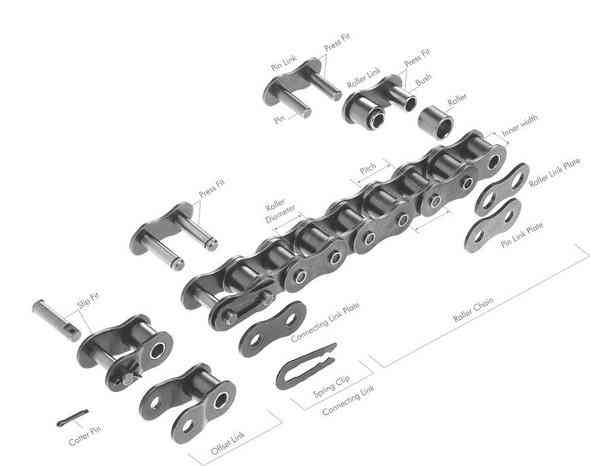
There are many different factors to consider when purchasing a roller chain. One of the most important factors is tensile strength, which represents the force required to break the chain. Roller chains are available in three different tensile strengths: minimum, average and ultimate. Each strength reflects a different limit to the load the chain can handle. However, these limits are not always equal and you should be aware of the differences between roller chains.
Canonical chain
Most roller chains have standard sizes printed on the side panels. This is usually “40” or “C2080H”, but can also be the letter “B”. If the chain is old, it will need to be cleaned to see its size. You can find the size on the standard roller chain size chart, but not everyone is marked. To determine the size, measure the diameter and pitch of the chain, then compare the results to the chart to see what size you need.
Heavy-duty roller chains are available with heat-treated pins, side plates, and rollers. In addition to being heat treated, they are also factory pre-stretched, which reduces wear on these parts. If properly maintained, they can last for years, reducing the risk of failure or corrosion. Depending on the application, standard roller chains are available in different sizes. It can be purchased separately. There are several options to choose from, depending on the size and strength of the application.
PEER roller chains contain solid rollers to reduce shock loads on the sprocket teeth. Heat treating and preloading all components of the PEER chain helps minimize initial elongation. Hot-dip lubrication ensures complete lubrication of all chain components, extending their life and reducing maintenance costs. For heavy-duty applications, ASME/ANSI-B29.1 chain is a good choice.
Standard roller chains are made of steel or alloy steel. However, it can be made of other materials such as stainless steel. In addition to steel, stainless steel is often used in food processing machinery where chain lubrication is an issue. Brass and nylon are also sometimes used. However, they are not that popular. Therefore, you should always check with your supplier before purchasing. By comparing the tensile strength of two different chains and making an informed decision, you can get the best price and service.
Chain without bushing
Bushless roller chains have advantages over conventional roller chains. Unlike conventional chains, bushless chains have extensive lateral flexibility, which increases the chain’s lubrication flow. The inner plates of bushless chains have protruding shoulders so the oil can flow through them more easily and efficiently. This is an important characteristic of a smooth-running chain. Additionally, bushless chains may have improved shifting performance.
The strength of a bushingless roller chain is measured in terms of tensile strength and fatigue strength. The former measures the load a chain can withstand before breaking. Fatigue strength is equally important, and factors that affect fatigue strength include the steel used to make the chain components, the pitch hole fabrication, the type of shot peening on the chain, and the design and thickness of the chain. For example, if the chain is too thin, it may not be enough for heavy-duty applications.
Like traditional roller chains, bushingless roller chains have two different types of links. The inner link has two inner plates connected by pins, while the outer chain has two outer plates held together by bushings. A bushingless roller chain is similar to a traditional chain, except it eliminates a step in the assembly process by stamping the tube into the inner plate. So if you want a smoother ride, a bushingless roller chain is a better choice.
There are two different sizes of bushingless roller chains. One size is designed for use with standard single-strand chains, while the other size is designed for use with double-strand or triple-strand chains. Bushless chains are generally shorter than conventional chains, so they can fit in tighter spaces. Bushless chains are made of the highest quality materials. These chain attachments are case hardened for optimum strength and durability.
Mute chain
The silent roller chain has a smooth, low-noise drive. They are made of stacked rows of flat chainplates with a gear-like profile that meshes with the sprocket teeth. Each chainplate is attached to a corresponding sprocket, which also allows the chain to bend. While these basic components are the same for every silent roller chain, there are many variations that allow them to be used in a variety of applications.
The most popular high-speed transmission, silent chains feature gear-like sprockets. They can be made from single or multiple strands of material. Single-strand chains are less expensive than multi-strand chains, but they tend to wear out faster if not lubricated. Single-strand roller chains can be used for years without lubrication, but for your application, wide silent chains are still worth considering.
The design and construction of silent chains make them ideal for conveying a wide variety of products. They have flat, heat-resistant surfaces. They are also durable and non-slip. They are available in a variety of pitch sizes, widths, and mounting styles. Whether you need chains for general purpose conveyors or glass bottle transport applications, we have you covered. Ask about the benefits of silent roller chain conveyors.
Inverted tooth chains are another option for quieter chains. These chains are designed to reduce noise from engine-related friction. Silent chains are more common, and manufacturers have fallen in love with them. A silent chain consists of several links connected to the sprocket teeth. Teeth rotate to reduce noise, vibration, and chord action. These are the main reasons why silent chains are so popular.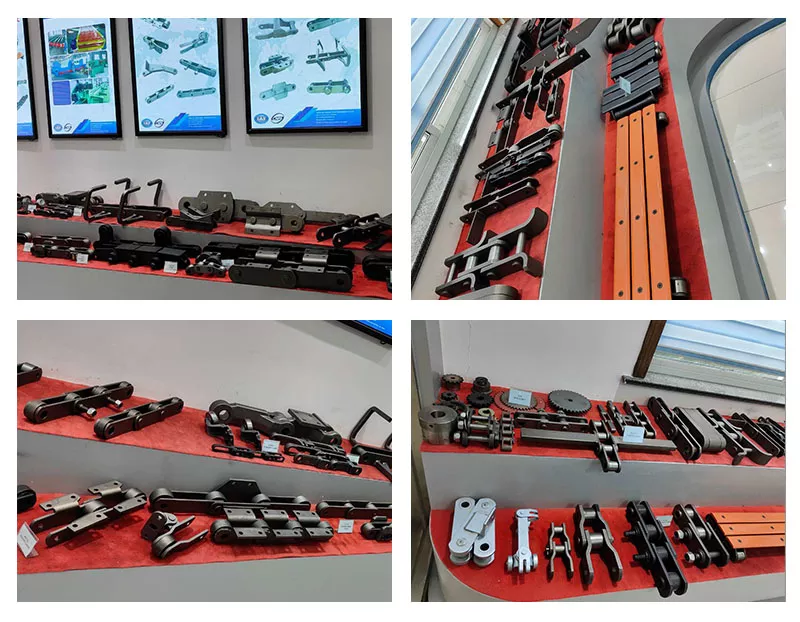
ANSI chain pitch
To measure your bike’s chain pitch, you can use a caliper. This measurement is taken from the center of the rolling pin to the center of the next rolling pin. Chains come in many sizes, but ANSI is the most common chain standard in the United States. A caliper is handy if you’re not sure which size to buy, as it allows you to check for worn sprockets.
Chains that meet ANSI standards will be characterized by a certain pitch. This measurement is based on the width and spacing of the roll. The spacing is usually greater than the width. The standard number will be the right number for the width of the chain or the left number for the rollers. The number on the left indicates whether the chain is lightweight or heavyweight. Heavyweight chains are designated by the suffix “H”.
Common chain sizes are based on ANSI chain pitch. Pitch is the minimum distance between bushing and sprocket. The smaller the chain pitch, the greater the total distance between the two points. This means the chain will last longer. However, if you are buying a chain for a specific application, you should check the pitch carefully as it can affect the performance of the chain.
Roller chain wear measurement
The purpose of roller chain wear measurement is to prevent breakage by monitoring the strain on the chain. There are several ways to measure roller chain wear. The first is to remove the chain from its working position and measure the distance from the sprocket to its measuring end. Another way is to measure the pitch of the chain or the distance between two pins. This method is superior to other methods because it is convenient and accurate.
When measuring the wear of a roller chain, it is important to note that the elements of the chain will gradually deform. About 3.75% of the total wear will be on the pins and the rest will be on the internal links. These wear measurements will vary based on the nominal pitch of the chain and the amount of friction the chain is experiencing. Proper lubrication between pins and bushings, load and frequency of articulation all affect wear rates.
It is important to measure the amount of wear on the roller chain to avoid excessive machine failures. The longer the chain runs, the more wear it will wear. Although the length of the chain should be less than the center distance, the excessive load will cause premature wear. Therefore, lubrication is essential. Additionally, the sag of the chain should not exceed 2% to 4% of its center-to-center distance. Finally, check for unusual noise or visible defects. A common cause of excessive roller chain wear is the size of the load. Every chain manufacturer sets a maximum workload for its product.
There are several ways to measure roller chain wear. If using a high-speed drive, it should have at least 11 teeth, and a medium-speed drive should have at least 25 teeth. Also, be sure to check the length of the chain, even if you should. The same goes for the pin diameter, which should be the same or different pitch as the roller chain.
editor by Cx 2023-06-15
China best 08b 10b 12b 16b 20b ISO/ANSI British Standard Customized OEM Short Pitch Long Pitch Plate Bush Industrial Chain Transmission Chain Conveyor Chain Roller Chain brush grubber chain
Product Description
| Model NO. | 06C/08A/10A/12A/16A/20A/24A/28A/32A/40A/06B/08B/10B/12B/16B/20B/24B/28B/32B/40B-1/2/3 Heavy duty |
| Chain Model | Roller Chains |
| Structure (for Chain) | Roller Chain |
| Specification | GB/T, DIN, ANSI, ISO, BS, JIS. |
| Origin | HangZhou, ZheJiang |
| Color | Solid Color |
| Chain Color | Customized |
Our company
Wolff Chain Co. is 1 of the professional chain manufacturers in China. We focus on reseaching, manufacturing and trading of the chain drive with famous brands — “DOVON” and “DECHO”. We supply OEM services for many famous enterprises such as SUZUKI, XIHU (WEST LAKE) DIS., FAW, AGCO, JUMING as well.
Wolff mainly producing the Transmission chains,Conveyor chains,Dragging Chains,Silent chains,Leaf chains,Roller chains,Special chain and many other series of chain products. Our technicians a have improved the chains quality to the world-level. High quality material selection, powerful and precise heat-treatment technology and excellent assembly methods ensure Wolff chains meet the tough and strict requirements for machines and vehicles.
All of our products completely conform to the international standard such as ISO\DIN\ANSI\BS\JIS, etc. Wolff has been successfully certified by ISO9001 Quality Management System,SGS inspection and BV inspection. Wolff chains can be widely applied to many industries including automobile, motorcycle, forklift, wood processing machine, constructure machine, packing machine, food machine,tobacco machine and agricultural equipments. Wolff chains are popular in America,South America,Europe,Middle East, South East Asia and Africa markets.
Our workshop
Our certification
Welcome to our exhibition
FAQ
Q1. What is your terms of packing?
A: Generally, we pack our goods in single color box. If you have special request about packing, pls negotiate with us in advance, we can pack the goods as your request.
Q2. What is your terms of payment?
A: T/T 30% as deposit, and 70% before delivery. We’ll show you the photos of the products and packages
before you pay the balance. Other payments terms, pls negotiate with us in advance, we can discuss.
Q3. What is your terms of delivery?
A: EXW, FOB, CFR, CIF.
Q4. How about your delivery time?
A: Generally, it will take 25 to 30 days after receiving your advance payment. The specific delivery time depends
on the items and the quantity of your order.
Q5. Can you produce according to the samples?
A: Yes, we can produce by your samples or technical drawings. We can build the molds and fixtures.
Q6. What is your sample policy?
A: We can supply the sample if we have ready parts in stock, but the customers have to pay the sample cost and
the courier cost.We welcome sample order.
Q7. Do you test all your goods before delivery?
A: Yes, we have 100% test before delivery
Q8: How do you make our business long-term and good relationship?
1. We keep good quality and competitive price to ensure our customers benefit ;
2. We respect every customer as our friend and we sincerely do business and make friends with them,
| Standard or Nonstandard: | Standard |
|---|---|
| Application: | Textile Machinery, Garment Machinery, Conveyer Equipment, Packaging Machinery, Food Machinery, Marine, Mining Equipment |
| Surface Treatment: | Oil Blooming |
| Structure: | Roller Chain |
| Material: | Carbon Steel |
| Type: | Short Pitch Chain |
| Samples: |
US$ 0/Piece
1 Piece(Min.Order) | |
|---|
| Customization: |
Available
| Customized Request |
|---|
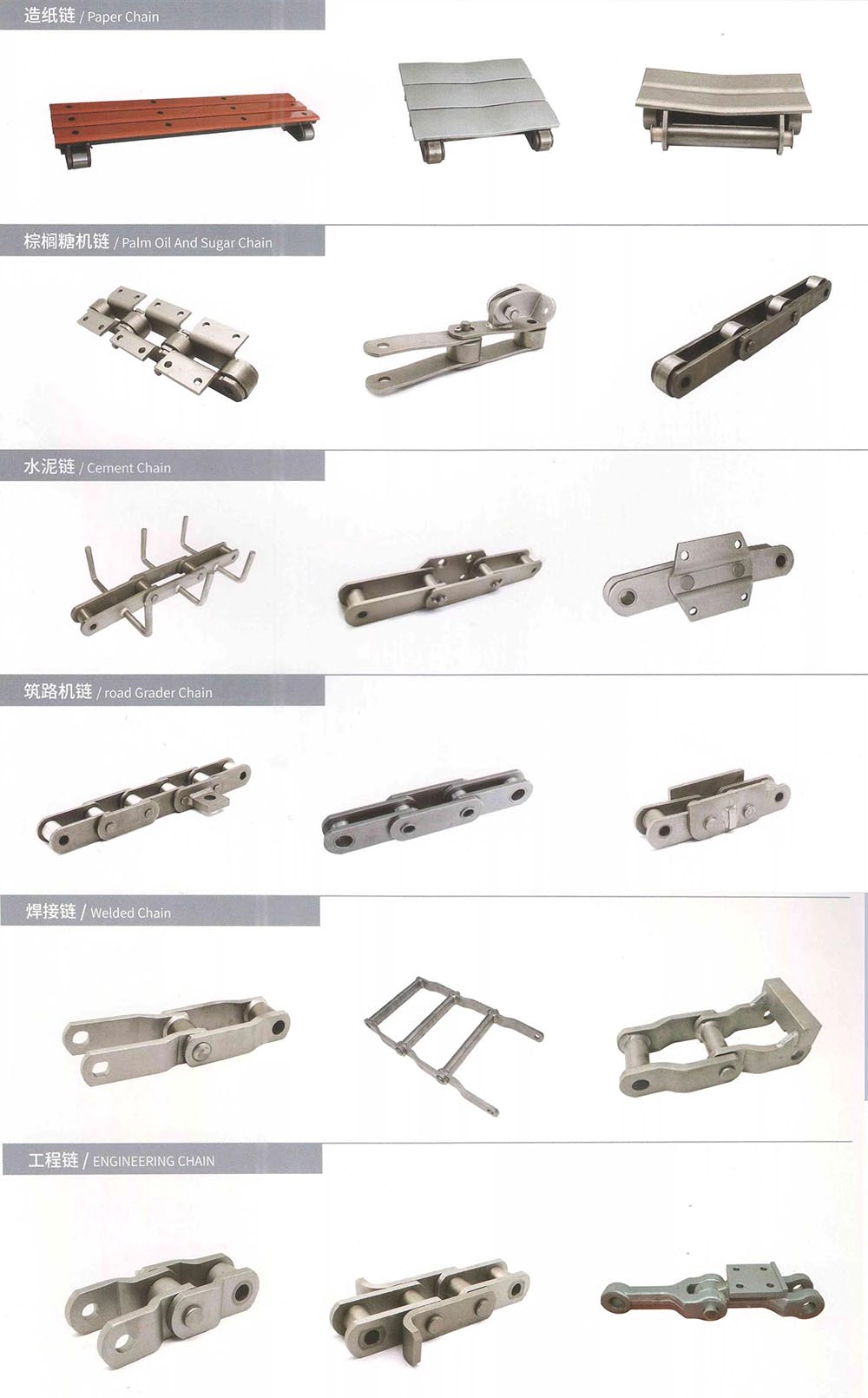
Advantages and disadvantages of roller chains
If you need to lift heavy objects, you should know how to use a roller chain. Its simple design and simplicity make it ideal for a wide range of applications. This article will discuss the advantages and different types of applications of roller chains. After reading this article, you will be able to choose the type of roller chain that best suits your specific needs. In the next section, we’ll discuss how to deal with it.
Put on
How to measure the wear of a roller chain? There are several methods available, but the most accurate is to use a wear gauge kit. The CZPT Chain Wear Indicator Kit measures chain elongation. Compliant with ANSI and British Standards, this tool is critical to the industry chain and can help you determine when replacement is required. Improper chain maintenance can cause equipment to slip or perform poorly, resulting in unnecessary downtime.
In addition to measuring the elongation of the roller chain, it is also possible to measure the pitch of the rollers. This measurement represents the ANSI #80 standard for roller chains. Vernier calipers can also be used to measure the pitch of chains. This tool is very useful and also acts as a bottle opener. You can even use it as a wear gauge. This way, you can determine if the roller chain needs to be replaced.
The wear resistance of a roller chain can extend its life by 10% or more. However, proper lubrication and general maintenance are essential to ensure the longest lifespan of your chain. The manufacturing process of a roller chain assembly also plays a crucial role in determining its service life. For longer life, you might consider purchasing a heavy-duty series roller chain with thicker side plates and longer pins. If you need greater working load capacity, you can also consider heavy-duty chains.
High-quality components are critical to the longevity of the roller chain. High-quality roller chain components require precise heat treatment processes. The use of proprietary steel allows the company to manufacture more durable drums. The pins are manufactured to tight tolerances and then undergo a centerless grinding process. This process removes any surface defects, resulting in a mirror finish on the pins. The uniformity of this surface finish also ensures that the load is evenly distributed on the pins, extending the life of the chain.
Material
Among the materials used in roller chains, carbon steel and alloy steel are the most common. However, stainless steel is used in food processing equipment and applications that require lubrication. Other materials used for roller chains include nylon and brass. For more information, see the USACE Material Specification Sheet for more information. You can also find information about the performance of a roller chain by its design. But before choosing one of these materials, consider its pros and cons.
Stainless steel is an excellent choice for roller chains. It is corrosion-resistant and can operate in extreme temperatures without cracking. Stainless steel is a non-magnetic material that can operate in a temperature range of -200 degrees to +700 degrees Fahrenheit. In addition to its corrosion-resistant properties, stainless steel can withstand a variety of environments and can be used in heavy-duty applications. The MEGA series is the strongest stainless steel roller chain in the world.
Application
As the name suggests, a roller chain has 5 basic components: pins, bushings, rollers, and pin chainplates. These components are precision engineered to ensure optimum performance and durability. Typical applications include drives and conveyor belts. The various components of the roller chain can be customized to specific needs. Read on to learn more about how these parts work together. This article presents the advantages and disadvantages of different types of roller chains and discusses their applications.
A roller chain is a form of chain drive consisting of short cylindrical rollers connected together by side links and gears called sprockets. While these devices are simple, they have some limitations. In most cases, sprockets must be designed with a maximum tensile load on one tooth to prevent premature chain failure. Therefore, these chains are less efficient than belt drives with higher inertia.
Roller chains are usually made of carbon or alloy steel, although stainless steel is often used where food processing machinery and lubrication are problematic. Sometimes, nylon and brass are used. The maximum running speed of the roller chain is important for some applications, but it also provides economic benefits for users and manufacturers. The maximum running speed of a roller chain is usually governed by a wear limit, which can vary by application.
The global roller chain market is expected to grow at a CAGR of over 5.4% over the next six years. The research report covers the competitive landscape and key factors influencing the market. The report also analyzes the growth potential, product utilization, and pricing models of key vendors. It also covers the SWOT analysis of the key players in the industry. The study provides a comprehensive market analysis of all these factors and more. It also highlights key players and their strategies and identifies the fastest growing regions for their products and services.
Maintain
Because rollers are exposed to a variety of environments, including snow, rain, and muddy roads, regular maintenance is required to prevent damage. Because they must encounter these elements frequently, frequent inspections are important to prevent rust and other damage. Also, avoid pouring acidic or alkaline cleaning products on the roller chain. Instead, use hot water with hand sanitizer or a disposable toothbrush to clean the rollers. Washing the chain directly with water has little effect.
For small rollers, the workload during the break-in period should not be too large, otherwise, it will cause overheating. The small drum should also be inspected frequently for any unusual appearance, which may indicate that the system is not functioning properly. In this case, the operation must be suspended. Failure to do so could result in serious injury or a facility fire. Additionally, a properly lubricated roller chain is essential to ensure long-term performance.
The surface of the roller is often rusted and scratched. Over time, these little scars can spread to the drive, damaging it. Also, the chain may not be properly spaced and timed. Therefore, it is very important to check regularly to ensure that the chain is in top condition. When the chain wears to 3% or more, the entire roller chain needs to be replaced. Failure to do so may damage the drive, the roller sprocket, or the entire chain.
Given the chain’s processing environment, lubrication is critical to its performance. If the chain is lubricated, it must be re-lubricated frequently. However, lubricated roller chains are susceptible to contamination, especially in the biomass industry. In these environments, airborne organic particles and debris from the biomass industry can contaminate lubricated roller chains. This is why maintenance is important for lubricating roller chains.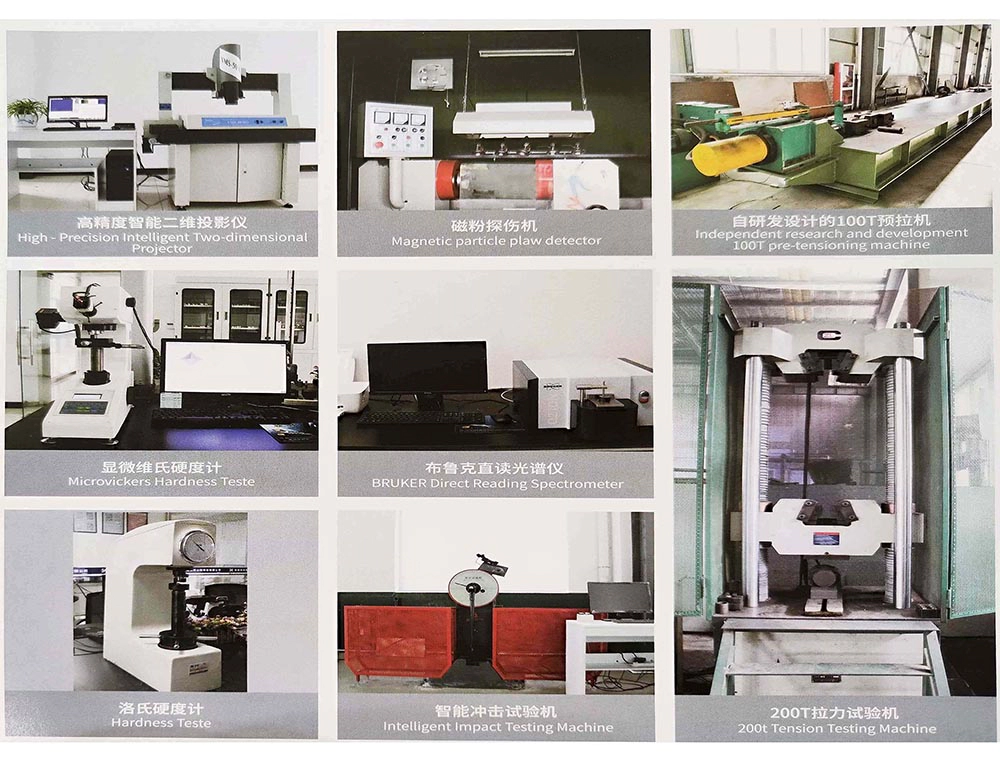
Preloading
The benefits of preloading roller chains are well documented. In general, preloading eliminates the initial elongation of the roller chain, increasing its service life. Preloading is an effective way to achieve this, and a preloading chart can help illustrate the benefits of this process. Chains with little or no preload will stretch significantly during drive start, while chains will stretch rapidly as the surface hardness of the wear parts increases. Additionally, a properly preloaded chain has little or no elongation during the initial start-up of the drive, extending wear life.
Premium manufacturers apply the preload concept during their production phase, aligning all major components at the same time. This approach helps eliminate elongation issues that lead to rapid degradation of the roller chain. If this is not checked, the chain drive will stretch immediately over time. To avoid these problems, it is important to purchase a high-quality preloaded roller chain from a reputable source.
The heat treatment process is an effective way to prevent excessive wear of the roller chain. Heat treatment is a complex process that takes place in a factory during manufacturing. This process helps the rollers maintain high hardness and depth, preventing breakage. When buying a roller chain, make sure that the chain is heat treated and that the chain is manufactured to a high degree of precision. It also ensures that the product can be used for a long time.
In addition to performance benefits, preloading can also reduce initial elongation. A preloaded roller chain will exhibit near linear elongation, whereas a non-preloaded chain will experience rapid elongation. Therefore, they will reach the recommended 3% elongation earlier. Make sure the chain is properly lubricated. Also, consider how the chain is arranged. This is critical for optimal longevity.
editor by CX 2023-06-13
China Standard ISO Standard Short Pitch Precision Simplex Hardware Motorcycle Industrial Roller Chain blind roller chain
Product Description
ISO Standard Short Pitch Precision Simplex Hardware Motorcycle Industrial Roller Chain
Product Description
1. Material: Alloy Steel
2. Surface Treatment: Shot peening
3. Application: The product is mainly applied in small lifting.
4. Chain No: 40-1, 50-1, 60-1, 80B-1, 10B-1, 12B-1, etc.
| Product name | ISO Standard Short Pitch Precision Simplex Hardware Motorcycle Industrial Roller Chain |
| Materials Available | 1. Stainless Steel: SS304, SS316, etc |
| 2. Alloy Steel: 45Mn, 42CrMo, 20CrMo, etc | |
| 3. OEM according to your request | |
| Surface Treatment | Shot peening, Blackening, Oxygenation, Polishing, Zinc-plated, Nickel-plated, Anodized, etc. |
| Characteristic | Fire Resistant, Oil Resistant, Heat Resistant |
| Design criterion | ISO DIN ANSI & Customer’s Drawing |
| Size | Customer’s Drawing & ISO standard |
| Package | Wooden Case / Container and pallet, or made-to-order |
| Certificate | ISO9001: 2008 |
| Advantage | Firtsr quality, Best service, Competitive price, Fast delivery |
| Delivery Time | 20 days for samples. 45 days for official order. |
Detailed Photos
View more products,please click here…
Company Profile
| Usage: | Transmission Chain |
|---|---|
| Material: | Alloy |
| Surface Treatment: | Oil Blooming |
| Feature: | Oil Resistant |
| Chain Size: | 40-1, 08b-1 |
| Structure: | Roller Chain |
| Samples: |
US$ 0/Meter
1 Meter(Min.Order) | |
|---|
| Customization: |
Available
| Customized Request |
|---|
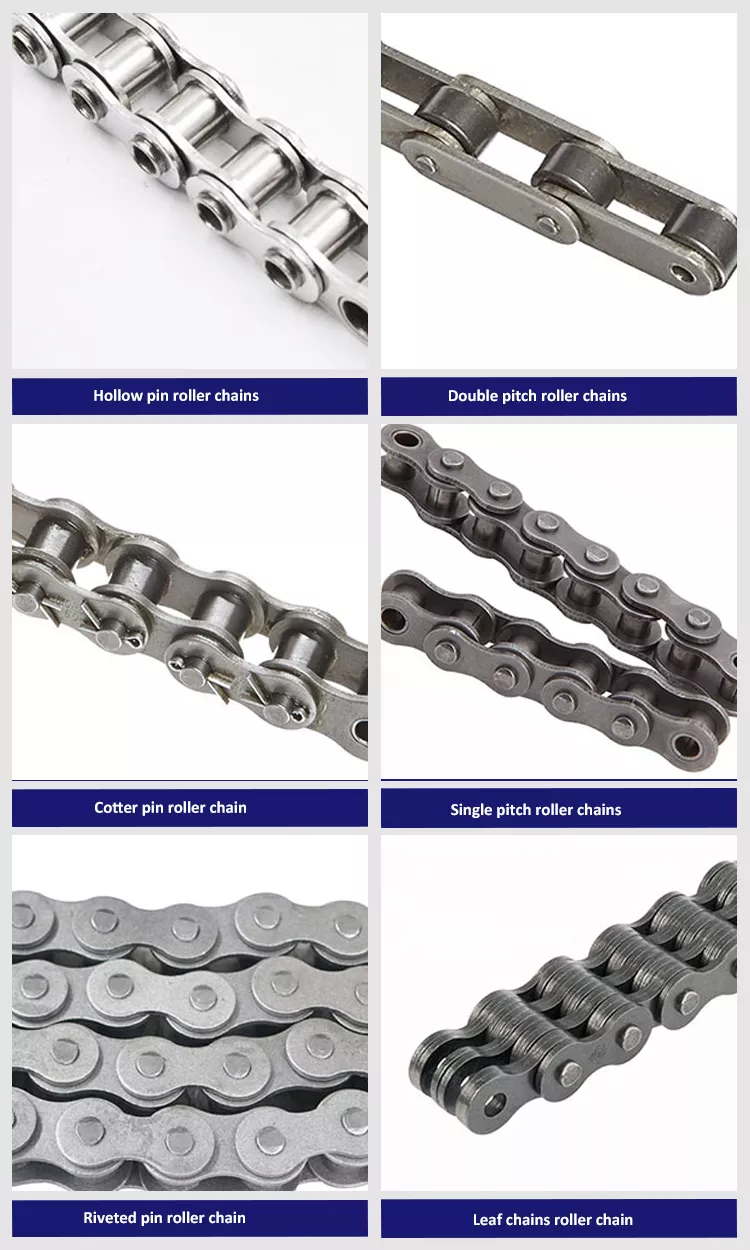
How to choose a roller chain for a conveyor
When choosing a roller chain for your conveyor, the easiest way is to refer to the horsepower and RPM charts. The horsepower and rpm of the small drive sprocket will determine the size and number of teeth of the chain. Conveyor chains are available in a variety of options, including moving products horizontally, vertically, or around a bend radius. When choosing a conveyor chain, consider the purpose of the chain. For example, if you’re delivering products to customers’ doorsteps, you might choose chains that can move products up and down a hallway or warehouse.
Double pitch
Double pitch roller chains are a popular way to drive agricultural equipment. It has twice the pitch of a standard roller chain and is ideal for light-duty drives. Extended pitch increases performance at lower speeds, but requires fewer components per foot than standard single-pitch chains. Compared to single-pitch roller chains, double-pitch chainplates are longer and are suitable for lighter loads. Read on to learn more about double pitch chains and how they can improve your operation.
The most common type of conveyor chain is double pitch. It is used in the auto parts industry, as well as in the precision machinery industry. It is made from the same components as the standard drive roller chain, except it has longer side plates. Double pitch chains are often used on slow-moving conveyors to reduce the stress placed on them. Industries that commonly use double pitch conveyor chains include airport equipment manufacturers, lumber mills, and fruit packing plants.
RS series roller chains are manufactured from high-quality stainless steel. It has excellent chemical and abrasion resistance and is available in a variety of cord lengths. RS sprockets have over 30 teeth. They contain all the necessary connection links for easy installation. PEER Chain offers double pitch roller chain attachments including pre-stretched chains, sprockets, and other attachments.
Double pitch roller chains have several advantages over standard chains. Double pitch chains have double the pitch, making them ideal for conveying applications such as conveyors. In addition to that, it also provides ANSI-compliant styles. These chains also have free connection links. When shopping for a double pitch roller chain, be sure to choose the one that fits your requirements and budget. They will last longer and save you money in the long run.
Double pitch roller chains to ANSI standards feature oversized rollers. These chains are best suited for applications where the product is mounted on top of the chain. They are ideal for agricultural applications where cotton is on top of the drum. Also, this type of chain is used in light-duty conveyors and agricultural applications. You can find double pitch roller chains in a variety of sizes and styles. And, as long as you know what you want, you’ll be happy with the results.
Self-lubricating
Self-lubricating roller chains eliminate the need for manual relubrication, providing long-lasting operation and reducing maintenance costs. These chains are particularly popular in industries such as the food and beverage industry, textiles, printing, and sawmills. They can also replace standard roller chain drives and conveyor chains. Manufactured to the specific standard ISO R606, these chains are ideal replacements for conventional chains. PC chains are particularly beneficial for food and beverage production and packaging applications due to their anti-corrosion properties.
Self-lubricating roller chains meet ISO, ASME/ANSI, and DIN standards. They are interchangeable with standard chains of the same size and shape and can be used in a variety of industrial applications. Self-lubricating chains have special oil-impregnated sleeves to reduce maintenance time. These chains are also suitable for applications where cleanliness is an issue.
Self-lubricating roller chains are manufactured with unique RS attachments. Rather than a traditional roller chain with an external lubricating ring, this type of chain retains the lubricant within its bushings. During operation, the application generates heat, heating the lubricant, which flows out of the pin and bushing area. Therefore, CZPT roller chains are ideal for certain food conveying applications.
In addition to self-lubricating roller chains, carbon steel, stainless steel or nickel-plated steel are also available. Self-lubricating roller chains are available in different sizes depending on the application, including 0.375″ wide profile straight-chain, extended pin chain, and four-link. In addition, these chains are also available in ANSI and BS chain specifications.
Accumulation
Whether you need to move large or small loads, accumulating roller chains are a viable solution. This chain conveyor is designed with low back pressure to transport large and bulky items with minimal noise. Free-running rollers within the chain help create a smooth build-up surface. These chains are available in a variety of options, including accumulating rollers of different pitches.
The accumulation and release roller chain 14 includes an upper part 15 and a lower part 16. The upper part 15 rests in the upper subspace 28, while the lower part 16 rests on the top side 20 of the profile. As the upper belt 15 rolls around the accumulation roller chain 14, it aligns with the lower chain 16 to form a continuous receiving space. This arrangement allows the accumulation roller chain 14 to rest on the top surface of the support profile 11.
A cumulative roller chain consists of many individual parts. Each section of the chain has an elongated cylindrical shape and is connected to each other by hinged joints. Each chain section also has an accumulation and release roller associated therewith. Each roller protrudes from the upper side 20 and the lower side 21 of the chain portion. The accumulation rollers are movable about an axis 22 extending transversely to the longitudinal axis of the chain.
A feature of the stacking and releasing roller chain is its simplicity. The conveyor has a profiled section that is permanently divided into two cross-sectional spaces. The bottom space is closed from all sides. The upper space accommodates the conveyor line. The contoured portion includes an opening that guides the bottom strap. A shunt can also be inserted between the two sections. The accumulating roller chain system is a convenient and versatile way to move bulky items.
There are many different types of accumulating roller chains. Some chains have offset rollers for optimal load distribution. Others have protection to prevent machine wear. Some run without lubricant, which is a safety advantage. In addition to protection, cumulative chains can also provide protection. The side bow version of the accumulation and release roller chain with offset accumulation and release rollers is designed for conveyor systems with very small bend radii.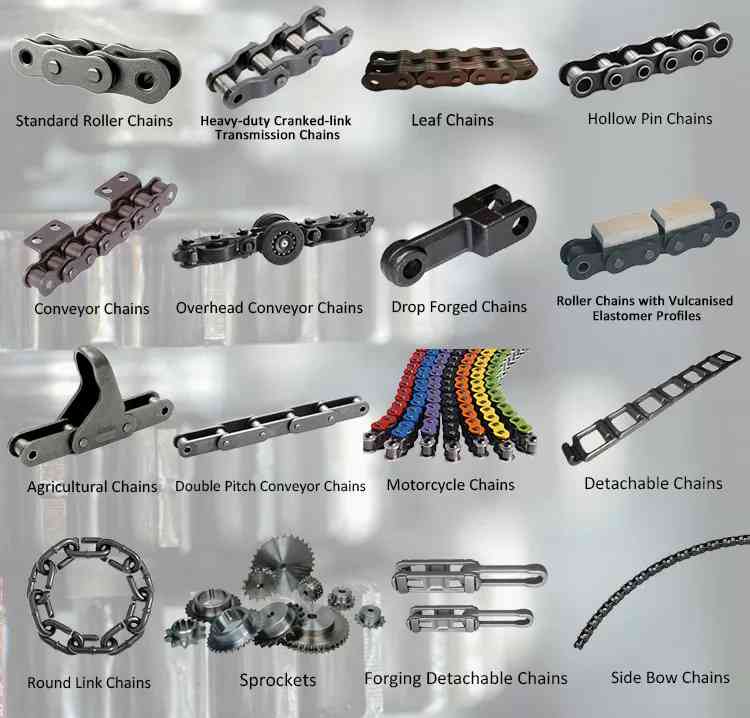
Without bushing
Bushless roller chains are the most common type of industrial chain. They are simple in design and require only regular maintenance. Regular maintenance includes lubricating, assessing wear, and replacing worn sprockets. For more information, please read the following information:
The outer chainplates and the inner chain plates are alternately arranged in pairs. The connecting pin extends through the hole in the inner link plate. The rollers thus positioned can be rotated on the connecting pins. Oil provided between the outer circumferential surfaces of each connecting pin serves to lubricate the chain. This system reduces noise and wears caused by collisions between inner chain plates and sprockets.
Compared to traditional roller chains, bushings roller chains have rollers around the bushing. These rollers are in rolling contact with the sprocket teeth, providing low friction and excellent wear resistance. To ensure smooth operation, bushings roller chains must be greased to prevent rust and keep the chain properly tensioned. Lubricated chains run smoother and last longer.
In a bushingless chain, the inner links are shaped like half bushings and ride on the rollers. The pins go through the outer plate and connect the inner links to the rollers. The outer plates overlap the inner links and open the pins. This system is also known as a heterochain. This type of chain is more common than traditional roller chains. If you are not sure which type of bushingless roller chain to choose, you may need to purchase an additional pair of inner chainplates.
Linerless roller chains may also include chain guides. In a bushingless roller chain, the outer and inner link plates conform to the surfaces of the guide rails. Thus, the large area of contact between the chain and the guide rail is eliminated, the friction loss is reduced, and the power transmission efficiency is improved. These properties make bushless roller chains more efficient and durable than traditional roller chains. It’s also less noisy. If you are looking for a chain with a lower noise level, a bushingless roller chain may be the right choice for you.
editor by CX 2023-06-02
China high quality DIN818-2 Standard G30/G43/G80 Q235 20mn2 25mnv Lifting Chain (D5mm-D68mm) 30 Years Chain Factory double pitch roller chain
Product Description
OUR PRODUCTS
DIN818-2 Standard G30/G43/G80 Q235 20Mn2 25Mnv Lifting chain(D5mm-D68mm) 30 Years chain factory
| (SIZE AND WEIGHT): | ||||||
| SIZE d*t MM | WIDTH b1 MIN b2MAX | WEIGHT KG/M | APPRAX LOAD KN | TEST LOAD KN | BREAKING LOAD MIN KN | |
| 6*8 | 7.5 | 21 | 0.79 | 1.1 | 27 | 45.2 |
| 7*21 | 9 | 24.5 | 1.07 | 1.5 | 37 | 61.6 |
| 8*24 | 10 | 28 | 1.38 | 2 | 48 | 80.4 |
| 10*30 | 12.5 | 35 | 2.2 | 3.2 | 76 | 125 |
| 11*43 | 12.6 | 36.5 | 2.33 | 3.8 | 92 | 154 |
| 12*36 | 15 | 42 | 3.1 | 4.6 | 109 | 181 |
| 13*39 | 16.3 | 46 | 3.8 | 5 | 128 | 213 |
| 14*42 | 18 | 49 | 4.13 | 6.3 | 150 | 250 |
| 15*46 | 20 | 52 | 5.17 | 7 | 168 | 280 |
| 16*48 | 20 | 56 | 5.63 | 8 | 192 | 320 |
| 18*54 | 23 | 63 | 6.85 | 10 | 246 | 410 |
| 19*57 | 23.7 | 63.2 | 7.7 | 11.3 | 270 | 450 |
| 20*60 | 25 | 70 | 8.6 | 12.5 | 300 | 500 |
| 22*66 | 28 | 77 | 10.7 | 15.3 | 366 | 610 |
| 23*69 | 29.9 | 85.1 | 10.2 | 16 | 415 | 665 |
| 24*72 | 32 | 82 | 12.78 | 18 | 432 | 720 |
| 25*75 | 32.5 | 92.5 | 14.1 | 20 | 491 | 785 |
| 26*78 | 35 | 91 | 14.87 | 21.3 | 510 | 850 |
| 28*84 | 36.4 | 104 | 17.6 | 25 | 616 | 985 |
| 30*90 | 38 | 105 | 19.6 | 28.3 | 678 | 1130 |
| 32*96 | 40 | 106 | 22.29 | 32.2 | 772 | 1286 |
| 36*108 | 46.8 | 133 | 29 | 40 | 1571 | 1630 |
| 40*120 | 52 | 148 | 36 | 50 | 1260 | 2571 |
| 45*135 | 58.5 | 167 | 45.5 | 63 | 1590 | 2540 |
| 48*144 | 60 | 170 | 52 | 72.5 | 1450 | 2900 |
Our Services
1. Prompt reply for inquiry within 24 hours
2. One on one service guarantees you the best purchasing experience.
3. Strong production capacity and professional technical engineer can gusrantee the delivery time and quality.
4. Strict quality control.
| Usage: | Transmission Chain, Conveyor Chain, Dedicated Special Chain, Lifting Mining Fishing Marine Rigging Lashing |
|---|---|
| Material: | Alloy |
| Surface Treatment: | Polishing |
| Feature: | Rust-Resisting Material |
| Chain Size: | D3mm-D64mm |
| Structure: | Welded Chain |
| Samples: |
US$ 150/Ton
1 Ton(Min.Order) | |
|---|
| Customization: |
Available
| Customized Request |
|---|
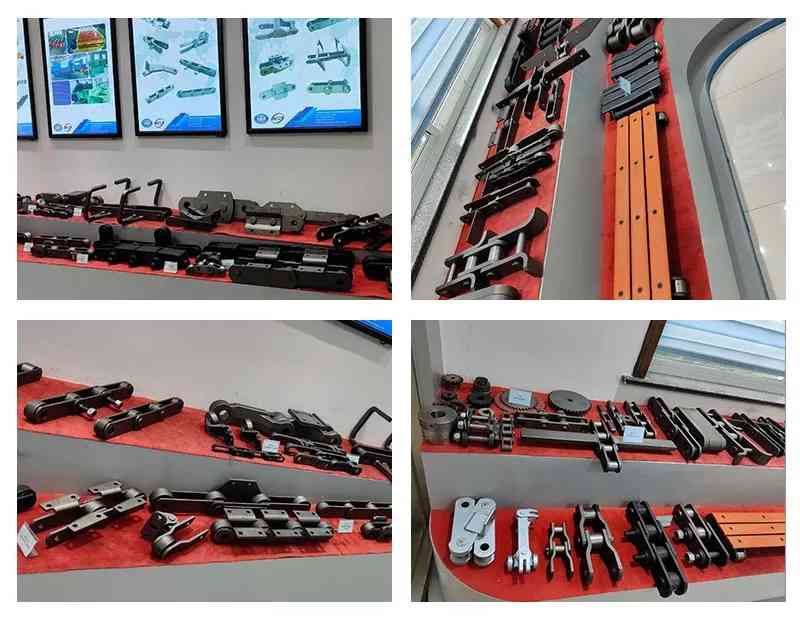
Advantages and Disadvantages of Drive Chains
Drive chains are widely used for sliding steel guides. While solution chains are often used, roller chains are more efficient in size and weight. Nevertheless, a drive chain is often the best choice for dirty jobs. The following are some of the benefits and disadvantages of drive chains. Learn more! Adapt your vehicle to your specific situation with drive chains. You’ll be glad you did! Read on to learn more! Continue reading for information on different types of drive chains.
Inverted tooth chain
An inverted tooth camshaft drive chain has teeth on its links and two pin rolling pivot joints that engage each other to transmit moderate to high-speed rotations. This type of drive chain is also known as a silent chain drive, which is particularly effective in reducing noise and vibration. The teeth on the links mesh perfectly with the teeth of the gear sprocket. The inverted tooth design also provides smooth communication of chain links with the teeth of the sprocket.
The design of the new model was particularly effective in quelling noise. The “Druid” spring forks enabled the chain to adjust with minimal motion of the axle. It was launched at the 1910 Olympia show and sold more than 500 units. The drive chain was also silent, which reduced the need for sound insulation and attenuation components, which in turn minimized weight. Hence, it became an ideal choice for wind turbines.
The main disadvantages of chain drive include its low speed and limited range. It is expensive to manufacture and requires precise mounting. Maintenance is essential, including lubrication and slack adjustment. Its velocity fluctuates as the chain is stretched. This causes the chain to fail at the worst possible time. The chain drive also has problems associated with slippage. In addition, it can be prone to excessive wear and tear. Fortunately, however, there are newer types of drive chains available, which are more durable and reliable.
Duplex chain
There are three types of duplex drive chains: SC, RP, and Ramsey. Each has their own unique advantages and features. The Rampower duplex series offers twice the power capacity of the standard SC duplex chain. They are often used in new applications. SC duplex chains are the most affordable and are used in less demanding applications. The SC duplex chain has a lower power capacity but lower weight. There is also no guarantee of performance.
Multi-strand roller chain
The Multiple-strand roller chain for drive chain market can be defined on the basis of the factors that drive growth in this industry. The factors that hamper market growth can be understood in order to come up with alternative bends for lucrative opportunities. This report aims to understand the current scenario and the impact of COVID-19 on the industry as a whole. We will also discuss the market drivers and restraints. We will discuss the various types of Multiple-strand roller chains for drive chain and their market sizes in the coming years.
The minimum tensile strength for a roller chain is one sixth or one-ninth the tensile strength of a conventional drive chain. These standards are established to prevent linkplate fatigue, which is the main cause of premature breakdown. A chain made of this material is considered a superior choice for high-performance applications involving a high load-bearing capacity. If you’re using a drive chain, make sure to choose a proper chain based on the type of application. A simple chain with a high load-bearing capacity is also ideal for simple applications.
While it is true that a high-tension, high-speed drive requires a higher power rating than a low-speed chain, roller chains are primarily used in low to mid-speed applications. They are similar to bicycle chains but may have a master link. In motorcycles, chains are heavier and may require a chain tool to remove. These chains are often replaced with toothed belts or a combination of both.
Flat top chain
The flat top drive chain is a versatile conveyor belt that conveys medium and large workpiece pallets. Its arcing capacity makes it suitable for continuous drive combinations involving curve arcs. The flat top chain is also available with PA wear pads on the workpiece pallets. The flat top chain’s steel and plastic glide profiles allow surface loads of up to 1.5 kg/cm. HD profiles are compatible with the flat top chain.
The steel flat top chain is available in several types: 815, 820, and 881 series. These are heat-treated to have high strength and excellent wear resistance. They can also be used with various sprockets, including 820 sprockets. The high-quality steel chain can be used with many industrial applications. However, if you are looking for a durable chain for your industrial application, iwis hardened stainless steel flat top chains are an excellent choice.
TSplus flat top drive chain offers the most flexibility of any conveying media. The drive units can be linked end-to-end to form extended conveyor lines. Side-flexing flat top chains are available to create serpentine, in-line, and carousel conveyors. Drive units are available in standard and heavy-duty models. They are versatile enough to handle a variety of container sizes. If you need a more complex conveyor system, you can choose a heavy-duty drive chain.
Rexnord flat top chains come in two basic styles: MatTop chain and TableTop chain. The TableTop chain is molded in standard widths ranging from 3.25 inches to 12 inches. These are shipped in ten-foot sections, but you can also find 20-foot-wide mattop chains. You can even customize your MatTop chain to meet your exact needs. They are perfect for a variety of conveying applications, from general conveying to wash down applications.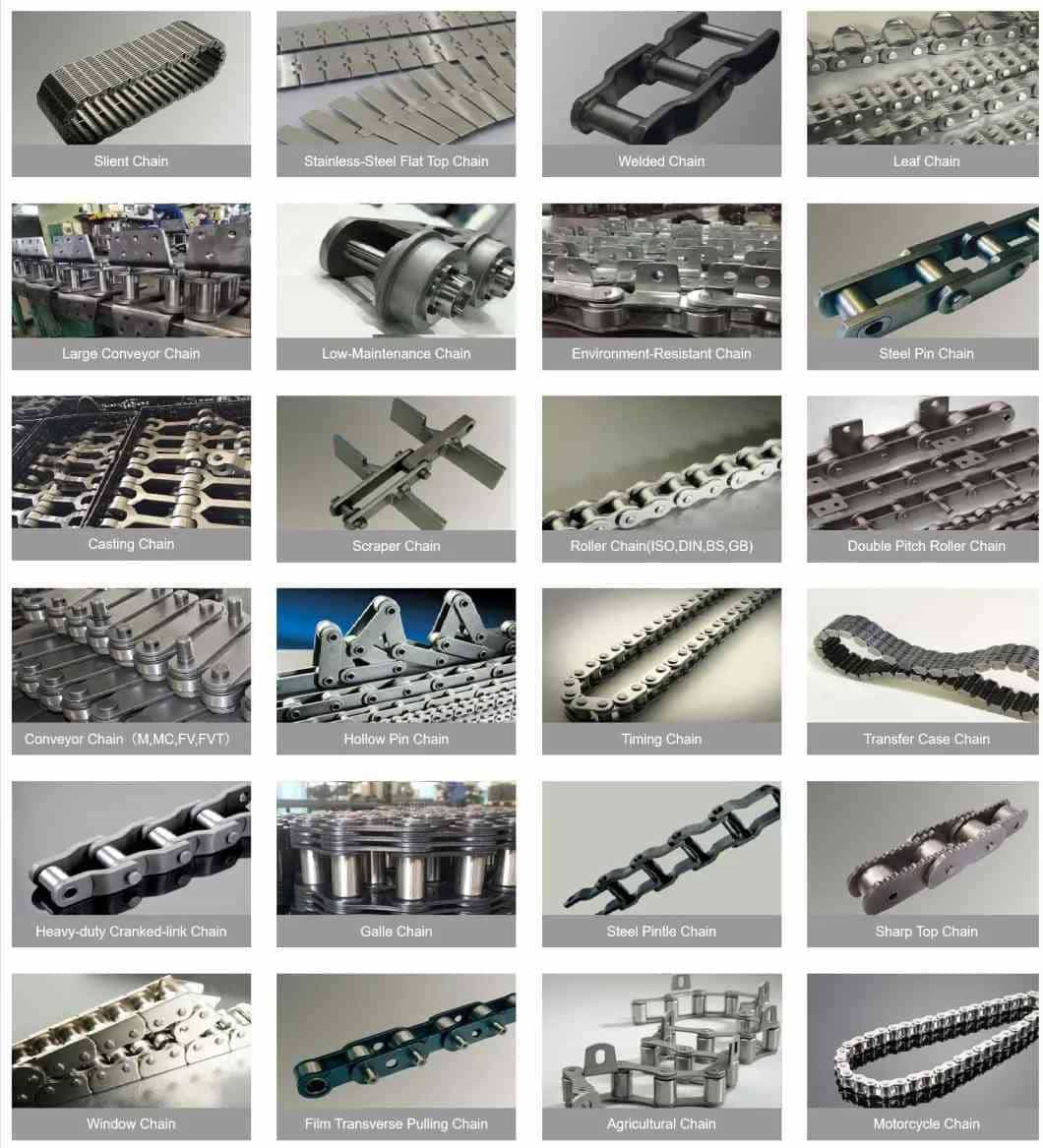
Conveyor chain
Drive chains for conveyors come in a variety of styles. These chains can have varying degrees of pitch. Pitch is governed by wheel tooth strength, the overall chain rigidity, and the type of drive motor. A normal maximum pitch is determined by the width of the link plates and the angle between the mounting angles. You can increase the pitch of your chain by strengthening the bushes between the link plates. Make sure that the gap between the wheel teeth and the bushes is approximately one-fourth inch.
Pitch and tension of the chain are important considerations when choosing a chain. The minimum pitch is determined by the thickness of the tooth on the wheel and the maximum pitch is determined by the rigidity of the link plates. However, this maximum pitch may be exceeded with bushes between the link plates or clearance with the wheel teeth. A good quality chain will have bearing surfaces lubricated to prevent excessive wear and rust. Medium-viscosity mineral oil is suitable for normal operating conditions. SAE 20W-50 is a good choice for this application. Self-lubricating chains are available from many chain manufacturers.
The chain is usually lubricated by dripping oil between the links. This type of lubrication requires regular inspection of the conveyor chain. The amount of oil should be enough to prevent reddish brown discoloration on the chain joints. A lubricating oil should be applied on a daily basis, according to the manufacturer’s specifications. In order to ensure a longer life for your drive chain, make sure that you lubricate it on a regular basis.
editor by CX 2023-05-29
China Heat Resistant Double Pitch Conveyor Chain with Attachment roller chain conveyor
Solution Description
Heat Resistant Double Pitch Conveyor Chain with Attachment
Merchandise Description
one. Substance: Carbon Steel / Stainless Steel
2. Surface area treatment: Shot Peening / Zinc-Plated / Nickel-Plated / Dacroment-Plated, etc
3. Software: Produced to ANSI B29.4, these chains are utilised in conveyor apps when masses are minimal and speeds are reasonable. They are related to the Double-Pitch Electrical power Transmission chains, but with link plates that have an oval contour, and can be produced with possibly standard or more than-sized rollers. They are most typically discovered operating on conveyors of all shapes and measurements and can be provided with 1 or far more of our several attachments to have or express goods.
| Product name | Warmth Resistant Double Pitch Conveyor Chain with Attachment |
| Materials Available | 1. Stainless Steel: SS304, SS316, and so forth |
| two. Alloy Metal: 45Mn, 42CrMo, 20CrMo, and many others | |
| 3. OEM according to your request | |
| Area Remedy | Shot peening, Blackening, Oxygenation, Sprucing, Zinc-plated, Nickel-plated, Anodized, and so on. |
| Attribute | Fire Resistant, Oil Resistant, Heat Resistant |
| Layout criterion | ISO DIN ANSI & Customer’s Drawing |
| Measurement | Customer’s Drawing & ISO Standard |
| Deal | Wood Scenario / Container and pallet, or created-to-order |
| Certificate | ISO9001: 2008 |
| Gain | First quality, Very best provider, Aggressive price, Fast supply |
| Supply Time | twenty days for samples. 45 times for official order. |
Thorough Images
Check out a lot more items,please simply click listed here…
Organization Profile
|
US $1.1 / Meter | |
100 Meters (Min. Order) |
###
| Material: | Carbon Steel |
|---|---|
| Structure: | Conveyor Chain |
| Surface Treatment: | Oil Blooming |
| Chain Size: | C2040, C2042 |
| Feature: | Heat Resistant |
| Sample: | for Free |
###
| Samples: |
US$ 0/Meter
1 Meter(Min.Order) |
|---|
###
| Customization: |
Available
|
|---|
###
| Product name | Heat Resistant Double Pitch Conveyor Chain with Attachment |
| Materials Available | 1. Stainless Steel: SS304, SS316, etc |
| 2. Alloy Steel: 45Mn, 42CrMo, 20CrMo, etc | |
| 3. OEM according to your request | |
| Surface Treatment | Shot peening, Blackening, Oxygenation, Polishing, Zinc-plated, Nickel-plated, Anodized, etc. |
| Characteristic | Fire Resistant, Oil Resistant, Heat Resistant |
| Design criterion | ISO DIN ANSI & Customer’s Drawing |
| Size | Customer’s Drawing & ISO Standard |
| Package | Wooden Case / Container and pallet, or made-to-order |
| Certificate | ISO9001: 2008 |
| Advantage | First quality, Best service, Competitive price, Fast delivery |
| Delivery Time | 20 days for samples. 45 days for official order. |
|
US $1.1 / Meter | |
100 Meters (Min. Order) |
###
| Material: | Carbon Steel |
|---|---|
| Structure: | Conveyor Chain |
| Surface Treatment: | Oil Blooming |
| Chain Size: | C2040, C2042 |
| Feature: | Heat Resistant |
| Sample: | for Free |
###
| Samples: |
US$ 0/Meter
1 Meter(Min.Order) |
|---|
###
| Customization: |
Available
|
|---|
###
| Product name | Heat Resistant Double Pitch Conveyor Chain with Attachment |
| Materials Available | 1. Stainless Steel: SS304, SS316, etc |
| 2. Alloy Steel: 45Mn, 42CrMo, 20CrMo, etc | |
| 3. OEM according to your request | |
| Surface Treatment | Shot peening, Blackening, Oxygenation, Polishing, Zinc-plated, Nickel-plated, Anodized, etc. |
| Characteristic | Fire Resistant, Oil Resistant, Heat Resistant |
| Design criterion | ISO DIN ANSI & Customer’s Drawing |
| Size | Customer’s Drawing & ISO Standard |
| Package | Wooden Case / Container and pallet, or made-to-order |
| Certificate | ISO9001: 2008 |
| Advantage | First quality, Best service, Competitive price, Fast delivery |
| Delivery Time | 20 days for samples. 45 days for official order. |
Different types of drive chains
There are many different types of drive chains. You should be able to differentiate between roller chains, forged rivetless chains, double chains, flat-top chains, and helical chains by the terms used. This article will provide information on the different types of chains. Then, you can choose the right one according to your needs. If you haven’t purchased a chain yet, read this article to get started. It will also provide information on the pros and cons of each type.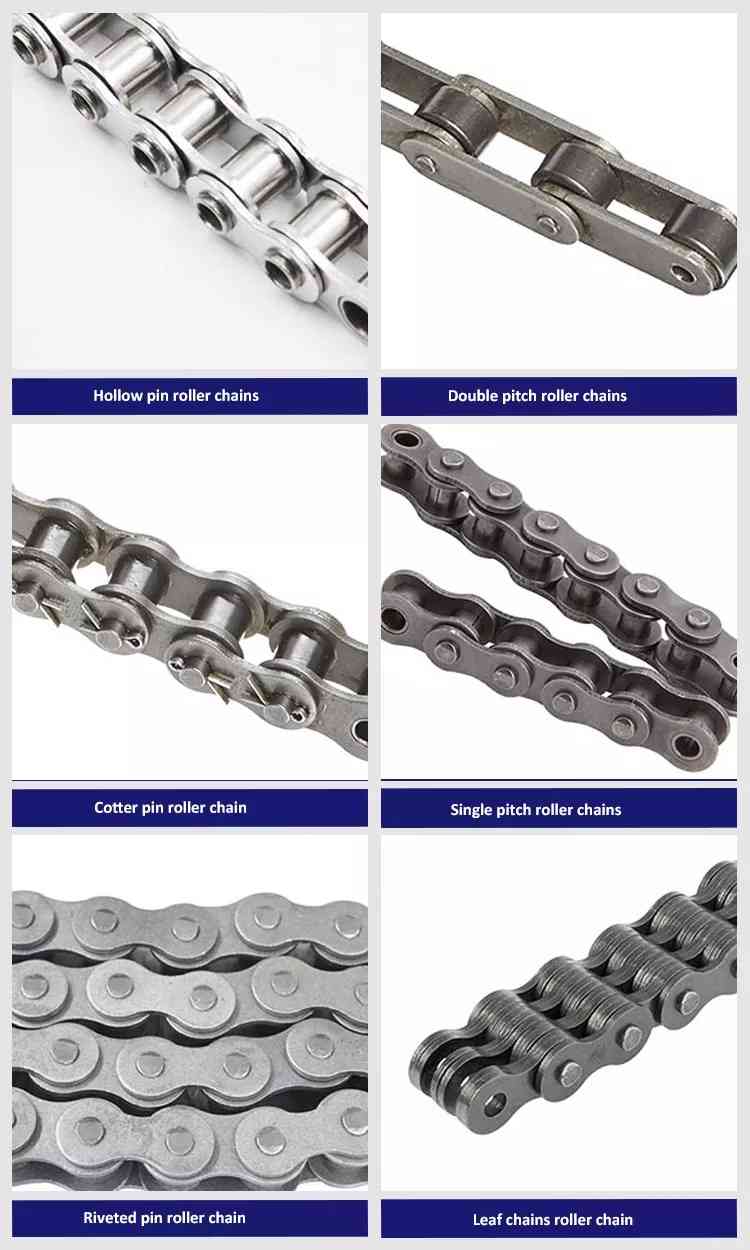
roller chain
There are several differences between drive chains and roller chains, but in essence, the two are functionally similar. The choice of which type to use depends largely on the type of environment it will be exposed to. While roller chains are suitable for clean indoor environments, they are not very forgiving when it comes to rubbing against the rails. Following are the main differences between a drive chain and a roller chain. Using the correct drive chain is essential for a smooth and efficient running machine.
Roller chain drive chains come in many different weights and tensile strengths. For light-duty applications, use a smaller pitch chain. For heavy-duty applications, use larger pitch chains. The design simplicity of these chains makes them ideal for a variety of applications. While they are great for a variety of applications, the durability of these chains makes them ideal for a variety of applications. Some of the main uses of roller chain drive chains are listed below.
When replacing the drive chain, be sure to follow the safety guidelines. The most important thing to remember is not to place the chain on a dirty floor as it may cause stretch or damage. After removing the chain from the sprocket, apply the measured load specified by ANSI to it. If the load exceeds this value, the chain may bend. A suitable load for measuring a drive chain should be at least six links.
While roller chains are usually made of carbon steel, some are made of stainless steel and are used in food processing machinery. In these environments, the chain may be made of stainless steel for lubrication. Brass and nylon are also sometimes used to meet these requirements. Regardless of the application, however, choosing the right drive chain is critical to the success of a roller chain machine. It is important to maintain the proper balance between the roller chain and the machine.
To properly use a roller chain, first determine the size of the sprocket used for the drive. The size of the chain should be smaller than the smallest sprocket to prevent tooth interference and provide adequate winding on the smaller sprocket. A good practice is to choose a drive chain with a center distance of 30 to 50 times the chain pitch. The longest possible center-to-center distance is approximately 80 times the chain pitch but is not recommended for high-speed applications.
Drop forged rivetless chain
Drop-forged rivetless drive chains are made of drop-forged steel components. Their proportions are suitable for strength and lightweight. Forged rivetless chains are generally divided into three types. Each of these types has its own set of important specifications. Key topics include minimum ultimate tensile strength, chain length tolerances, and link dimensions. Read on to learn more about each type and its uses.
One of the main features of forged rivetless chains is that, despite their relatively low price, they are designed to be very durable. The quality of a forged chain depends on the structure and design of the chain. The manufacturer of this type of drive chain is CZPT, which has a large stock of these chains. The chain is proof tested after assembly and comes with a two-year parts replacement warranty.
Forged rivetless chains are available in a variety of pitch sizes and strength grades. They are made of cast manganese or alloy steel and have an average strength of 24,000 to 300,000 pounds. These chains are suitable for automotive, conveyor, and material handling as well as meat packaging, sugar processing, and steel mill applications. They are also widely used in conveying systems. To ensure quality and performance, manufacturers offer a variety of forged chains.
CZPT offers forged CZPT drive chains for fatigue-free operation. The chain includes a solid one-piece forged drive pawl for optimum durability. Chains are available in Figure 8 and in D-shape styles. For more information, please contact CZPT directly. Custom Drop-Forged rivetless drive chains can be ordered. Manufacturers also offer custom chains for specific application needs.
double chain
Duplex drive chains have two sets of rollers instead of one, producing twice the power. Double chain roller chains have pins and roller bearings, while triple chain chains have an extra row of plates to accommodate the three sprockets. They are usually interchangeable with each other. They are available for US, UK, and ISO standards. They are made of carbon steel, stainless steel, and nickel or nickel-plated.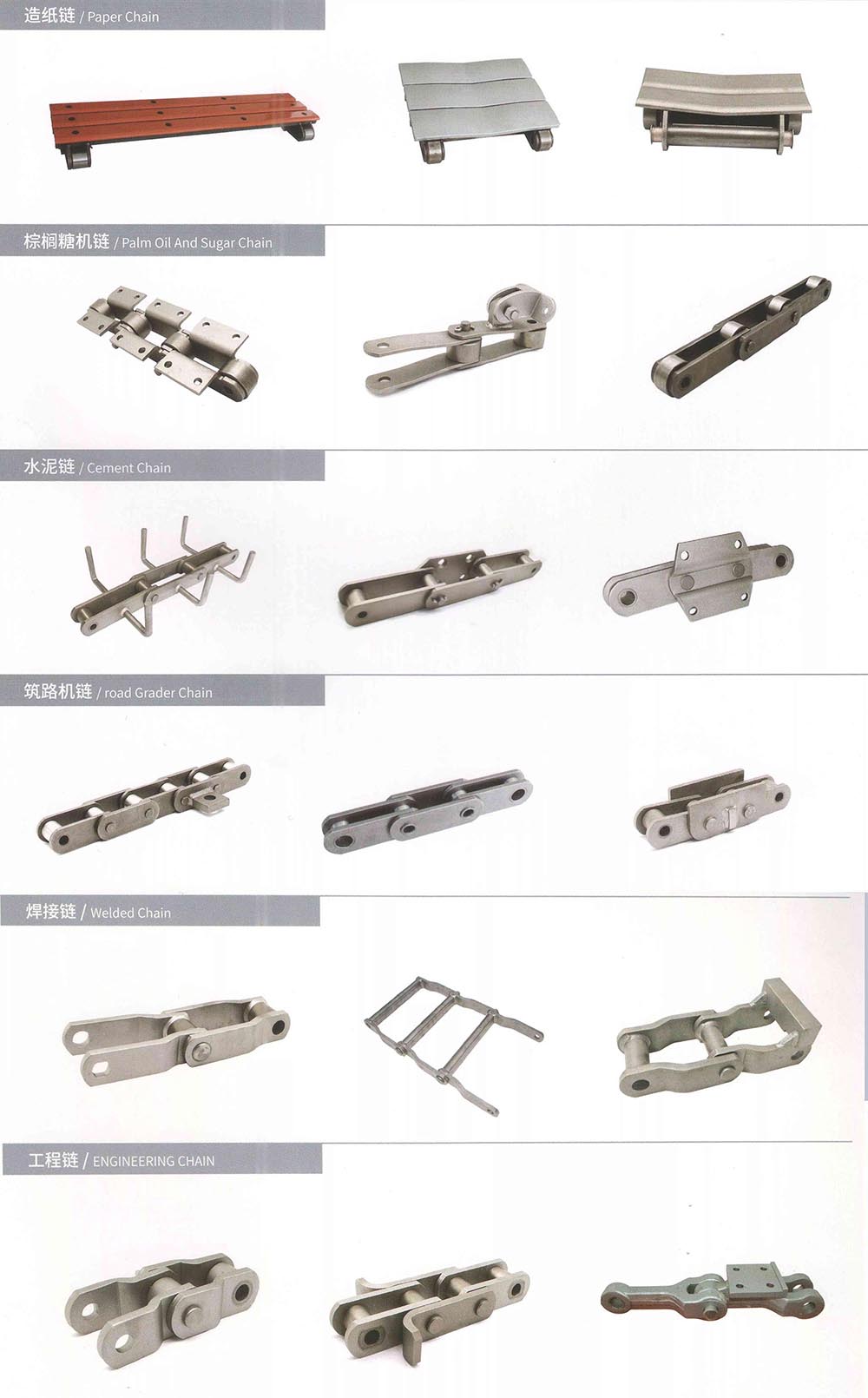
flat top chain
Flat-top drive chains are ideal for curved or straight tracks and come in many different types and thicknesses. These chains are highly resistant to wear and are usually made of steel, stainless steel, or plastic. CZPT manufactures special brands of flat-top chains with high wear resistance and excellent noise reduction. In addition to being versatile, flat-top chains can be used in a variety of industrial applications.
There are two main types of CZPT chains: solid top or raised rib. One piece is formed from a single unit link and the other has roller base links for added strength. The two-piece chain combines flat tabletop links and a roller bottom chain for added strength. These chains are available in widths up to 20 feet and are available in a variety of widths. These chains are available in stainless steel, cast iron, or plastic.
The hinge pin is another important part of the flat top chain system. Support chain plate to ensure smooth conveying. The hinges are available in single hinge pin and double hinge pin styles. Standard hinge pins are designed for straight, narrow-width chainplates; double hinge pins are designed for longer, heavier products. The hinge pins also come in many different materials, including aluminum and galvanized steel. This allows for customization based on machine design, operating conditions, and drive method.
Whether your flat-top chain conveyor system is large or small, a high-quality flat-top chain will get the job done. With their low maintenance and low maintenance design, these chains are easy to clean and maintain. They can accommodate workpiece pallets of various sizes, and their flexibility makes them ideal for many different applications. They can also be highly customized for various industries. So if you need an industry-specific conveyor, then a flat-top drive chain is the way to go.
editor by czh 2023-01-06
China Manufacturer Supply Industrial Chain Drive Chain Short Pitch Roller Chain 08b 16b Single Row roller chain end attachments
Solution Description
Merchandise Description
Proportions
Item title: roller chain
Main Products:
one. Timing Belt Pulley (Synchronous Pulley), Timing Bar, Clamping Plate
2. Forging, Casting, Stampling Part
3. V Belt Pulley and Taper Lock Bush Sprocket, Idler and Plate WheelSpur Gear, Bevel Gear, Rack
4. Shaft Locking Device: could be alternative for Ringfeder, Sati, Chiaravalli, Tollok, etc.
five. Shaft Coupling: including Miniature couplings, Curved tooth coupling, Chain coupling, HRC coupling,
Normex coupling, Type coupling, GE Coupling, torque limiter, Universal Joint 6. Shaft Collars: including Setscrew Type, Single Split and Double Splits
seven. Equipment & Rack: Spur equipment/rack, bevel gear, helical gear/rack.
8. Other customized Machining Parts according to drawings (OEM) Forging, Casting, Stamping Parts.
PACKING
| Packaging | |
| Packing
|
We use common export wood circumstance, carton and pallet, but we can also pack it as for each your particular needs. |
OUR Company
ZheJiang Mighty Equipment Co., Ltd. specializes in providing greatest services and the most aggressive value for our consumer.
Soon after in excess of 10 years’ challenging work, MIGHTY’s enterprise has developed rapidly and become an important partner for oversea clients in the industrial area and become a holding firm for 3 manufacturing factories.
MIGHTY’s products have acquired reputation of domestic and oversea customers with getting benefit of engineering, administration, good quality and very aggressive value.
Your fulfillment is the greatest inspiration for our perform, pick us to get higher quality products and best support.
OUR Factory
FAQ
Q: Are you investing organization or producer ?
A: We are factory.
Q: How lengthy is your delivery time?
A: Usually it is 5-ten times if the items are in inventory. or it is fifteen-twenty days if the merchandise are not in inventory, it is according to quantity.
Q: Do you provide samples ? is it cost-free or additional ?
A: Sure, we could offer the sample for totally free cost but do not pay out the expense of freight.
Q: What is your terms of payment ?
A: Payment=1000USD, thirty% T/T in advance ,harmony prior to shippment.
We warmly welcome friends from domestic and overseas appear to us for business negotiation and cooperation for mutual advantage.To provide buyers superb good quality goods with good price and punctual shipping and delivery time is our duty.
|
US $0.88-6.58 / Meter | |
1 Meter (Min. Order) |
###
| Standard or Nonstandard: | Standard |
|---|---|
| Application: | Textile Machinery, Garment Machinery, Conveyer Equipment, Packaging Machinery, Electric Cars, Motorcycle, Food Machinery, Marine, Mining Equipment, Agricultural Machinery, Car |
| Surface Treatment: | Standard and Custom |
| Structure: | Roller Chain |
| Material: | Stainless Steel |
| Type: | Standard and Custom |
###
| Samples: |
US$ 1/Meter
1 Meter(Min.Order) |
|---|
###
| Customization: |
Available
|
|---|
###
| Packaging | |
| Packing
|
We use standard export wooden case, carton and pallet, but we can also pack it as per your special requirements. |
|
US $0.88-6.58 / Meter | |
1 Meter (Min. Order) |
###
| Standard or Nonstandard: | Standard |
|---|---|
| Application: | Textile Machinery, Garment Machinery, Conveyer Equipment, Packaging Machinery, Electric Cars, Motorcycle, Food Machinery, Marine, Mining Equipment, Agricultural Machinery, Car |
| Surface Treatment: | Standard and Custom |
| Structure: | Roller Chain |
| Material: | Stainless Steel |
| Type: | Standard and Custom |
###
| Samples: |
US$ 1/Meter
1 Meter(Min.Order) |
|---|
###
| Customization: |
Available
|
|---|
###
| Packaging | |
| Packing
|
We use standard export wooden case, carton and pallet, but we can also pack it as per your special requirements. |
What is a roller chain?
What is a roller chain? A roller chain is a transmission system that transmits power from one shaft to another. Internal lubricant helps chains last longer and are interchangeable. Chains are usually made of carbon or alloy steel. Stainless steel is sometimes used in food processing machinery or in environments where lubrication is problematic. Brass and nylon are also sometimes used. If you need to slow down the machine, nylon chains can be used.
Roller chains are used to transmit power from one shaft to another
Generally speaking, the life of a roller chain is limited by three main factors: wear, corrosion, and fatigue. These can be minimized by following some simple guidelines. For optimum performance, the roller chain must be lubricated. Proper lubrication reduces friction and extends product life. Remember that corrosion and wind resistance can adversely affect lubrication, so protect the product properly.
A chain is a mechanical device used to transmit power from one shaft to another. The chain consists of a series of steel plates called bushings. Bushings are attached to the roller chain by pins or bushings. The block and bushing are held together by pins or bushings C riveted to the outer link D. The chain is also attached to the sprocket and bucket by pins or hooks. Chain pitch is measured between hinge centers, usually denoted p.
There are three types of chains: single-strand standard series, multi-strand standard series, and silent chain. Single strand chains are the most common type and cover a wide range of drive loads. Multi-strand chains provide greater power capacity without increasing chain pitch or line speed. An inverted tooth chain is a variant of a single-strand chain that eliminates the noise caused by pitch-related friction.
The inner and outer plates of the roller chain drive are made of steel. The rollers are positioned evenly between the chain links and are fastened to the sprockets. In addition, the rollers can rotate freely within the bushing. The chain links are arc-shaped and mesh with the sprocket teeth to transmit power through the chain.
Chain drives are another common way of transmitting mechanical power. These are the simplest forms of power transmission and are used on conveyor belts and other low-speed applications. The chain wraps around the sprocket and passes through the sprocket whose teeth mesh with the links. This mechanism transfers mechanical power from one shaft to another, increasing speed.
They are interchangeable
There are many different types of roller chains, but most are made of steel. Although they have their own advantages and features, they are generally interchangeable. You can buy different kinds of roller chains from domestic and foreign manufacturers, and you can choose the one that best suits your needs. Bearing Services can help you choose the right bearing for your application needs and budget. Here are some important things to consider before buying a roller chain. Here are some tips to make it easier for you to buy the right type of chain.
When choosing the right roller chain, be sure to consult the available size charts. Depends on how much chain you need to move the load you need to move. Remember that roller chains can be manufactured to fit a variety of machines and must meet your specific needs. Also, the chain should be long enough for the machine you are using. Make sure to buy a chain made of high-quality materials.
Double pitch roller chains have a flat top surface and are used in many different conveying applications. Double-pitch load-carrying roller chains, also known as oversized roller double-pitch chains, have rollers that extend beyond the sidebars to carry products. Double pitch drive series roller chains are used in elevators, long conveyor drives, agricultural machinery, and commercial sprinkler systems.
The tensile strength of a roller chain is a key factor to consider before purchasing a chain. The tensile strength of a chain is a function of the maximum force the chain can withstand before breaking. The three different types of tensile strength represent the force a chain can withstand without breaking. Each chain also has different strengths that can determine the type of chain you need.
The outer and inner links of the roller chain are designed for bearings. This allows the chain to be paired or unpaired with its internal links. The outer link has a pin, and the inner and outer pins are press-fit into the connecting plate. These links are usually made of steel and have a tensile strength of about 20 times their weight. The fatigue strength of two-pitch offset links is the same as that of the base chain.
They reduce wear with internal lubricants
In a roller chain, the pins and bushings rotate inside the chain without lubricant on the outside. They are in contact with the teeth of the sprocket and can easily wear out if not lubricated. The plates that connect the links and pivot about the pins can also rub against each other and cause wear. This is where lubricants come in handy. Without lubricant, the bare metal of the plate and bushing would rub against each other.
The lubricant should have the appropriate viscosity to penetrate critical internal surfaces and form an effective oil film. Recommended viscosities are listed in Table 1. Lubricants must be clean and non-corrosive. For roller chains, a good quality non-clean petroleum base oil is sufficient. While defoamers are not required, other additives such as antioxidants and extreme pressure inhibitors may be useful. However, impure oils should be avoided due to the risk of damage.
The shape of the spray head 10 overlaps with a conventional drive chain 12. The drive chain includes a plurality of rollers 24 and roller link plates 26. Each roller includes a roller pin 29 and is connected to a pair of pin link plates 28. Most drive chains have critical wear points on the sides of the roller pins 29. The shape of the spray head 10 prevents overspray onto the central portion of the roller.
In addition to preventing wear, these chains have unique specifications. Manufacturer CZPT requires raw material suppliers to certify that their products meet standards set by the American Society of Mechanical Engineers (ASME). CZPTs do not accept uncertified raw materials. For safety, the machine must be turned off before attempting to measure the chain. After the system is shut down, the measurement process should be completed in accordance with safety procedures.
General spray oil has lubricating properties, but is not as good as other types of chain lubricants. These are typically used for rust protection and include antioxidant chemicals. Generally, they are inexpensive and widely available in retail stores. However, they have the disadvantage of being very penetrating and difficult to apply evenly. Oil cannot stay on the chain as it spins, which can accelerate wear and corrosion.
They can be used to speed up or slow down machines
Typically, roller chains are chains used to move mechanical system components. Unlike belts, roller chains can be used to speed up or slow down a machine. The main difference between belts and roller chains is the lubrication process. Belts use lubrication to help them move at a constant speed, but should not exceed the critical speed of the roller chain. This critical speed is not easy to determine and lubrication is critical to its life.
A roller chain is a chain consisting of a steel bushing that holds the inner plate A and pins C together. Pin C is riveted to outer link D, while roller R surrounds each bushing B. The teeth of the sprocket are supported on the rollers. They spin freely on pins and bushings, reducing friction.
The chains can be single-stranded, double-stranded, or multi-stranded. The rated power capacity of the single strand chain can meet various drive load requirements. Multi-strand chains provide higher power capacity without increasing chain pitch or line speed. The silent chain, also known as the inverted tooth chain, consists of a series of toothed chainplates. The pins of the chain are pressed into the wide ends of the sidebars and outer links.
Although roller chains are a common mechanical component, they can fail under certain conditions. The most common cause of excessive wear is wrong to load sizing. Each manufacturer sets a maximum workload for its product. A chain that is too small for the load carried will not run smoothly and may cause premature failure. Chains can also fail due to rust or improper maintenance.
There are many ways to choose the correct size roller chain. The easiest way to choose the right one is to use a horsepower chart to determine the speed of the motor. RPM will determine the size of the chain and the number of teeth on the drive sprocket. Conveyor chains offer a variety of options to move products horizontally or vertically, even around bend radii.
editor by czh 2023-01-05
China Japanese Standard 316 Stainless Steel Link Chain double pitch roller chain
Merchandise Description
Japanese Common 316 Stainless Metal Url Chain
Solution Description
| Commodity | Japanese Regular 316 Stainless Metal Website link Chain |
| Dimensions | 2mm-12mm |
| Floor therapy | polish |
| MOQ | 500kgs |
| Offer potential | 500 Tons for every month |
| Supply time | Shipped in 30 times right after payment |
| Place origin | China |
| Experience | more than 20 a long time(since 1996) |
FAQ
Q: Are you a trading company or manufacture?
A: We are a real manufacture which specialized in link chain for around 20years and steel wire
rope for 10 years. Also, we have an independent trading company to deal with business of
rigging and related hardware.
Q: How do you control quality?
A: Selection of high-quality raw material.
Strict production procedure according to standard.
ISO quality management system certified.
Q. Where is your factory located?
A: It’s located in Chahe Industrial Zone, Xihu (West Lake) Dis., ZheJiang province, China, which is close to
ZheJiang .
Welcome to visit us!
Q. What’s your delivery time for a full container?
A: 30-40days is needed to ship out a full container.
Q: Does free samples available?
A: Yes, several links of chains can be provided for free but you need to cover the express
charge(DHL,UPS, FEDEX, TNT, EMS)
Ought to any products be of curiosity to you?Remember to do not hesitate to make contact with us.
|
US $3.38-6.15 / Meter | |
500 Meters (Min. Order) |
###
| Usage: | Drag Chain |
|---|---|
| Material: | Stainless steel |
| Surface Treatment: | Polishing |
| Feature: | Heat Resistant |
| Chain Size: | 2mm-12mm |
| Structure: | Welded Chain |
###
| Customization: |
Available
|
|---|
###
| Commodity | Japanese Standard 316 Stainless Steel Link Chain |
| Size | 2mm-12mm |
| Surface treatment | polish |
| MOQ | 500kgs |
| Supply ability | 500 Tons per month |
| Delivery time | Shipped in 30 days after payment |
| Country origin | China |
| Experience | more than 20 years(since 1996) |
|
US $3.38-6.15 / Meter | |
500 Meters (Min. Order) |
###
| Usage: | Drag Chain |
|---|---|
| Material: | Stainless steel |
| Surface Treatment: | Polishing |
| Feature: | Heat Resistant |
| Chain Size: | 2mm-12mm |
| Structure: | Welded Chain |
###
| Customization: |
Available
|
|---|
###
| Commodity | Japanese Standard 316 Stainless Steel Link Chain |
| Size | 2mm-12mm |
| Surface treatment | polish |
| MOQ | 500kgs |
| Supply ability | 500 Tons per month |
| Delivery time | Shipped in 30 days after payment |
| Country origin | China |
| Experience | more than 20 years(since 1996) |
Advantages and disadvantages of roller chains
If you need to lift heavy objects, you should know how to use a roller chain. Its simple design and simplicity make it ideal for a wide range of applications. This article will discuss the advantages and different types of applications of roller chains. After reading this article, you will be able to choose the type of roller chain that best suits your specific needs. In the next section, we’ll discuss how to deal with it.
Put on
How to measure the wear of a roller chain? There are several methods available, but the most accurate is to use a wear gauge kit. The CZPT Chain Wear Indicator Kit measures chain elongation. Compliant with ANSI and British Standards, this tool is critical to the industry chain and can help you determine when replacement is required. Improper chain maintenance can cause equipment to slip or perform poorly, resulting in unnecessary downtime.
In addition to measuring the elongation of the roller chain, it is also possible to measure the pitch of the rollers. This measurement represents the ANSI #80 standard for roller chains. Vernier calipers can also be used to measure the pitch of chains. This tool is very useful and also acts as a bottle opener. You can even use it as a wear gauge. This way, you can determine if the roller chain needs to be replaced.
The wear resistance of a roller chain can extend its life by 10% or more. However, proper lubrication and general maintenance are essential to ensure the longest lifespan of your chain. The manufacturing process of a roller chain assembly also plays a crucial role in determining its service life. For longer life, you might consider purchasing a heavy-duty series roller chain with thicker side plates and longer pins. If you need greater working load capacity, you can also consider heavy-duty chains.
High-quality components are critical to the longevity of the roller chain. High-quality roller chain components require precise heat treatment processes. The use of proprietary steel allows the company to manufacture more durable drums. The pins are manufactured to tight tolerances and then undergo a centerless grinding process. This process removes any surface defects, resulting in a mirror finish on the pins. The uniformity of this surface finish also ensures that the load is evenly distributed on the pins, extending the life of the chain.
Material
Among the materials used in roller chains, carbon steel and alloy steel are the most common. However, stainless steel is used in food processing equipment and applications that require lubrication. Other materials used for roller chains include nylon and brass. For more information, see the USACE Material Specification Sheet for more information. You can also find information about the performance of a roller chain by its design. But before choosing one of these materials, consider its pros and cons.
Stainless steel is an excellent choice for roller chains. It is corrosion-resistant and can operate in extreme temperatures without cracking. Stainless steel is a non-magnetic material that can operate in a temperature range of -200 degrees to +700 degrees Fahrenheit. In addition to its corrosion-resistant properties, stainless steel can withstand a variety of environments and can be used in heavy-duty applications. The MEGA series is the strongest stainless steel roller chain in the world.
Application
As the name suggests, a roller chain has 5 basic components: pins, bushings, rollers, and pin chainplates. These components are precision engineered to ensure optimum performance and durability. Typical applications include drives and conveyor belts. The various components of the roller chain can be customized to specific needs. Read on to learn more about how these parts work together. This article presents the advantages and disadvantages of different types of roller chains and discusses their applications.
A roller chain is a form of chain drive consisting of short cylindrical rollers connected together by side links and gears called sprockets. While these devices are simple, they have some limitations. In most cases, sprockets must be designed with a maximum tensile load on one tooth to prevent premature chain failure. Therefore, these chains are less efficient than belt drives with higher inertia.
Roller chains are usually made of carbon or alloy steel, although stainless steel is often used where food processing machinery and lubrication are problematic. Sometimes, nylon and brass are used. The maximum running speed of the roller chain is important for some applications, but it also provides economic benefits for users and manufacturers. The maximum running speed of a roller chain is usually governed by a wear limit, which can vary by application.
The global roller chain market is expected to grow at a CAGR of over 5.4% over the next six years. The research report covers the competitive landscape and key factors influencing the market. The report also analyzes the growth potential, product utilization, and pricing models of key vendors. It also covers the SWOT analysis of the key players in the industry. The study provides a comprehensive market analysis of all these factors and more. It also highlights key players and their strategies and identifies the fastest growing regions for their products and services.
Maintain
Because rollers are exposed to a variety of environments, including snow, rain, and muddy roads, regular maintenance is required to prevent damage. Because they must encounter these elements frequently, frequent inspections are important to prevent rust and other damage. Also, avoid pouring acidic or alkaline cleaning products on the roller chain. Instead, use hot water with hand sanitizer or a disposable toothbrush to clean the rollers. Washing the chain directly with water has little effect.
For small rollers, the workload during the break-in period should not be too large, otherwise, it will cause overheating. The small drum should also be inspected frequently for any unusual appearance, which may indicate that the system is not functioning properly. In this case, the operation must be suspended. Failure to do so could result in serious injury or a facility fire. Additionally, a properly lubricated roller chain is essential to ensure long-term performance.
The surface of the roller is often rusted and scratched. Over time, these little scars can spread to the drive, damaging it. Also, the chain may not be properly spaced and timed. Therefore, it is very important to check regularly to ensure that the chain is in top condition. When the chain wears to 3% or more, the entire roller chain needs to be replaced. Failure to do so may damage the drive, the roller sprocket, or the entire chain.
Given the chain’s processing environment, lubrication is critical to its performance. If the chain is lubricated, it must be re-lubricated frequently. However, lubricated roller chains are susceptible to contamination, especially in the biomass industry. In these environments, airborne organic particles and debris from the biomass industry can contaminate lubricated roller chains. This is why maintenance is important for lubricating roller chains.
Preloading
The benefits of preloading roller chains are well documented. In general, preloading eliminates the initial elongation of the roller chain, increasing its service life. Preloading is an effective way to achieve this, and a preloading chart can help illustrate the benefits of this process. Chains with little or no preload will stretch significantly during drive start, while chains will stretch rapidly as the surface hardness of the wear parts increases. Additionally, a properly preloaded chain has little or no elongation during the initial start-up of the drive, extending wear life.
Premium manufacturers apply the preload concept during their production phase, aligning all major components at the same time. This approach helps eliminate elongation issues that lead to rapid degradation of the roller chain. If this is not checked, the chain drive will stretch immediately over time. To avoid these problems, it is important to purchase a high-quality preloaded roller chain from a reputable source.
The heat treatment process is an effective way to prevent excessive wear of the roller chain. Heat treatment is a complex process that takes place in a factory during manufacturing. This process helps the rollers maintain high hardness and depth, preventing breakage. When buying a roller chain, make sure that the chain is heat treated and that the chain is manufactured to a high degree of precision. It also ensures that the product can be used for a long time.
In addition to performance benefits, preloading can also reduce initial elongation. A preloaded roller chain will exhibit near linear elongation, whereas a non-preloaded chain will experience rapid elongation. Therefore, they will reach the recommended 3% elongation earlier. Make sure the chain is properly lubricated. Also, consider how the chain is arranged. This is critical for optimal longevity.
editor by czh 2023-01-01